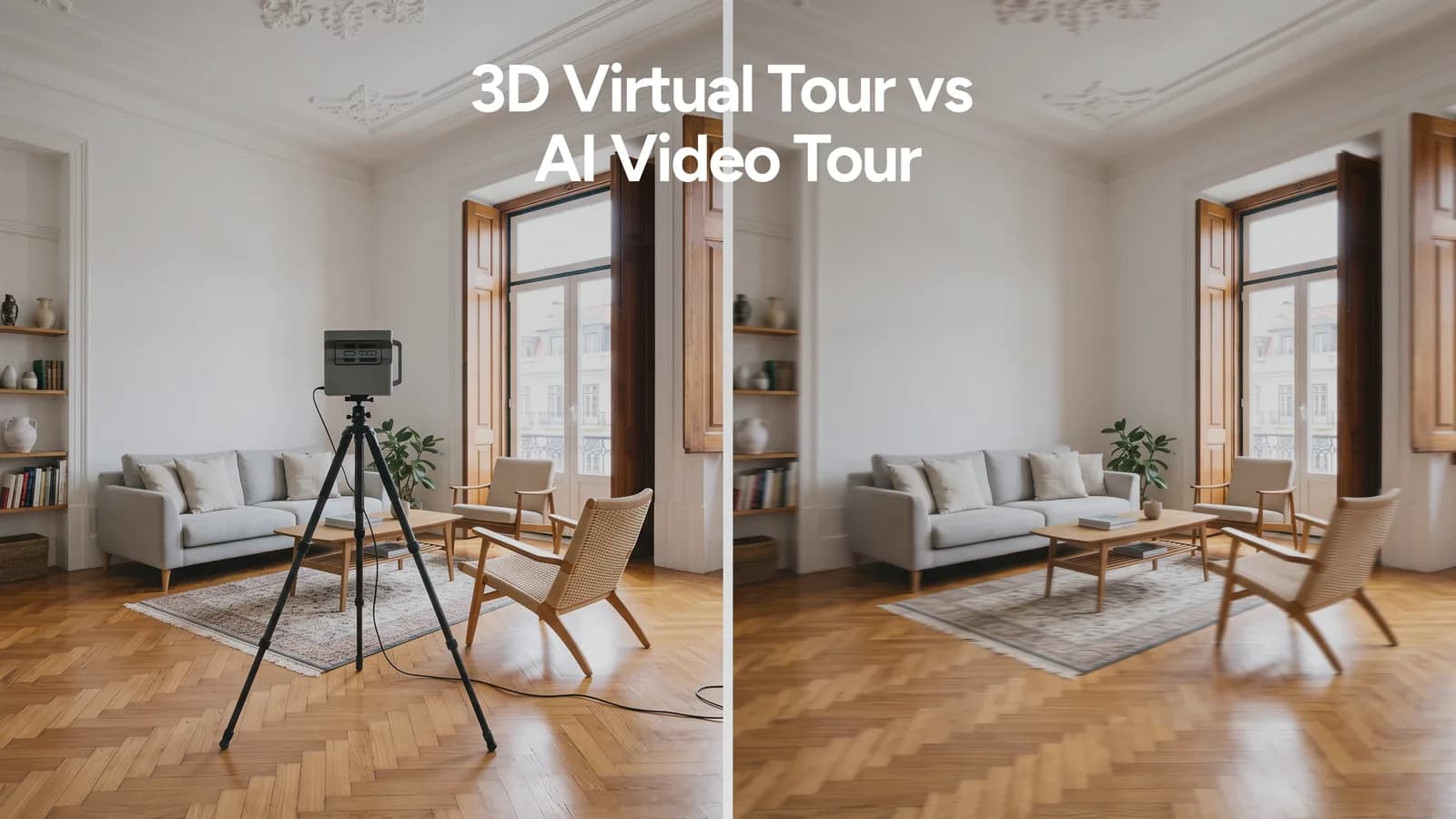
3D Virtual Tour vs AI Video Tour: Which Format Sells the Property

Stageless Team
“Virtual tour” is the term buyers type into Google. It is also a term that covers three different products: a 360 photo tour, a navigable 3D model, and a generated video walkthrough. They are made differently, they cost differently, and buyers use them at different points of the decision.
The agent choosing between them is not choosing a feature. They are choosing a cost structure and a viewing behaviour. A 3D tour asks the buyer to explore. A video tour walks the buyer through. One requires a site visit with specialist hardware. The other is generated from the listing photos you already have.
This guide defines the three formats, compares them point by point on cost, speed, equipment and buyer behaviour, and ends with a simple rule for deciding per listing. It is not a case for one format replacing the other. On some listings the right answer is both.
What “Virtual Tour” Actually Means in 2026
The term has stretched to cover any way of viewing a property remotely. Three formats sit underneath it, and confusing them is what leads agents to pay for the wrong one.
The 360 tour
A sequence of panoramic photos, usually captured with a 360 camera on a tripod, one position per room. The buyer stands in each panorama and looks around, then jumps to the next room. There is no model of the property, only linked spheres. It is the cheapest of the capture-based formats and the oldest.
The 3D tour
A navigable model of the property, captured position by position with a specialist camera, in most markets a Matterport or similar system. The software stitches the positions into a model the buyer moves through freely, including the dollhouse view that shows the whole property at once. It is accurate, measurable and interactive. It requires a site visit, hardware and hosting.
The AI video tour
A generated video built from still photographs. The AI reads each photo, produces camera movement through the space it shows, and connects the rooms in the order you set. There is no site visit beyond the one where the photos were taken, no extra hardware, no hosting subscription. The output is an MP4 the buyer watches rather than navigates.
The first two are capture formats: their quality is fixed at the moment of capture. The third is a generation format: its quality depends on the photo set you feed it. That difference drives almost everything in the comparison below.
How a 3D Virtual Tour Is Made
A 3D tour starts with access to the property and ends with a hosted link.
Someone, either the agent with a purchased camera or a certified technician, walks the property placing the camera at scan positions a few metres apart. A typical apartment takes 30 to 60 minutes to scan. The software processes the scans into the model, which is then hosted on the provider’s platform and embedded in the listing by link.
The cost has three possible shapes: buying the camera and paying a hosting subscription, hiring a certified technician per property, or a hybrid where the agency owns one camera shared across the team. Exact figures belong in a price comparison and change by market, so verify them against the provider’s current public pricing before quoting a seller.
What matters here is the structure of the cost, not the number. Every 3D tour requires a visit, a person, hardware and recurring hosting. The cost per property falls as volume rises, but it never approaches zero, and the scheduling never disappears.
How an AI Video Tour Is Made
An AI video tour starts with the photographs you already have.
You upload between 3 and 30 photos, assign each one to a room, set the order buyers should move through the property, and pick one of four visual styles. If you upload a floor plan the AI reads it and names the rooms for you, but the plan is optional. Generation takes 3 to 10 minutes and costs one video credit per tour, regardless of how many photos you include. Each photo becomes roughly five seconds of video. The output is a downloadable MP4 with a share link.
Stageless AI launched the feature in July 2026. The full walkthrough of how to do it well, including the shot list and the room order, is covered in our guide to creating an AI video tour.
The structural point mirrors the one above. There is no site visit, no hardware and no hosting. The cost per property is flat and the time from photos to published video is minutes. What the format cannot do is let the buyer wander off the path you set. The walkthrough is directed, not explored.
The Comparison, Point by Point
| 3D virtual tour | AI video tour | |
|---|---|---|
| Made from | On-site scan, specialist camera | Listing photos you already have |
| Site visit needed | Yes, dedicated | No, beyond the photo shoot |
| Time to delivery | 2 to 5 days typical | 3 to 10 minutes |
| Cost structure | Hardware or technician, plus hosting | One video credit per property |
| Buyer experience | Explores freely, self-paced | Watches a directed walkthrough |
| Works on social media | Poorly, needs a click-out | Natively, it is a video file |
| Works for empty properties | Shows them empty | Photos can be virtually staged first |
| Accuracy | Measurable, to scale | As faithful as the photo set |
Cost per property
The 3D tour concentrates cost in hardware, people and hosting. The video tour concentrates it in a single flat credit. The consequence is not that one is cheap and the other expensive. It is that the 3D tour only makes sense above a certain listing price, while the video tour makes sense on every listing including the €140,000 apartment that would never justify a technician visit. The full cost breakdown by format is in our pricing guide.
Time from photos to published listing
A 3D tour adds days: scheduling the scan, the visit itself, processing, embedding. A video tour adds minutes to a listing whose photos already exist. On a market where the first week of exposure drives most of the enquiries, days are not a rounding error.
Equipment and who can produce it
A 3D tour needs a camera that costs real money or a technician who does. A video tour needs nothing beyond the photos, which means every agent in the team can produce one without training, budget approval or a booking.
Who controls the walkthrough
This is the deepest difference and the least discussed. In a 3D tour the buyer chooses the route, lingers where they want, and can spend four minutes in the second bedroom. In a video tour the agent chooses the route, the pacing and what the buyer sees last. For a buyer deep in the decision, control is a gift. For a buyer scrolling a portal at midnight, direction is a gift. Neither is better in the abstract.
Where each format is seen
A 3D tour lives behind a click on the listing page. A video tour is a video file, which means it plays on the portal, on Instagram, in a WhatsApp message to a relocating buyer, and in an email. The formats do not compete for the same screen time. One serves the listing page. The other serves everywhere else.
Where the 3D Tour Wins
Be honest about this, because a comparison that declares one winner in every row is marketing, not guidance.
The 3D tour wins when the buyer needs to verify. International buyers deciding whether to fly in. Buyers who want to measure whether the sofa fits. High-value properties where a speculative viewing costs the seller staging effort and the agent half a day. Rental applications decided without a visit. In all of these, free exploration and measurable accuracy do work a directed video cannot.
It also wins on trust in one specific sense: a 3D tour is a capture of the property as it stands. Nothing in it was generated. For a buyer or a lawyer who needs the state of the property documented, that matters.
Where the AI Video Tour Wins
The video tour wins at the top of the funnel, which is where most listings are lost. It stops the scroll on portals and social media because it is motion, and motion is what feeds and portal algorithms increasingly reward with attention, even where no portal publishes it as a ranking factor.
It wins on every listing the 3D tour never reaches: the mid-market apartment, the rental, the listing where the seller will not pay for capture. It wins on speed, going live with the listing instead of days after. And it wins wherever the photos have been virtually staged, because the staged photos carry through into the video, while a 3D scan shows the empty rooms exactly as the camera found them.
What the Portals Accept
Most major portals accept both formats, but differently. Rightmove and Zoopla accept video and virtual tour links on the listing. Idealista, dominant in southern Europe, supports virtual tour links and video. The practical difference: a 3D tour is always a link out to the provider’s hosting, while a video tour is a file you can also upload natively where the portal allows it, and repurpose on every channel the portal does not control. Check the current spec of your portal before promising a seller either format.
Using Both on the Same Listing
On a high-value listing the formats stack cleanly. The video tour does the top of the funnel: portal card, social clips, WhatsApp sends. The 3D tour does the bottom: the buyer who watched the video and wants to verify before booking a flight. The video creates the interest the 3D tour then qualifies.
That is also the honest framing for a seller who asks which one you will use. Not “this one is better”, but “this one brings them in, this one convinces them”.
Disclosing a Generated Tour
A 3D tour needs no disclosure because nothing in it is generated. An AI video tour does. Under Article 50 of the EU AI Act, in force since 2 August 2026, the deployer carries the transparency duty for AI-generated content, and the deployer is you. Label the video as AI-generated and note it in the listing description. If the photos were virtually staged before the video was generated, disclose the staging too. It costs one line and protects the trust the tour is meant to build.
How to Decide, Listing by Listing
One rule covers most cases. Ask two questions of the listing.
First: will serious buyers need to verify this property remotely? If yes, because they are abroad, because the property is expensive, because visits are costly to arrange, budget for a 3D tour.
Second: does this listing need attention it is not getting? If yes, and that is nearly every listing, generate a video tour. The cost is one credit and the photos already exist.
Notice the questions are not exclusive. The premium listing answers yes to both and gets both. The mid-market listing answers yes to the second and gets the video. Almost no listing answers yes to neither.
Written by Stageless Team
We are a team of real estate technology experts passionate about AI. Our mission is to help agents sell faster by democratizing access to high-end virtual staging tools.