

Virtual Staging: The Complete Reference Guide for Real Estate Agents in 2026

Stageless Team
Editor in Chief
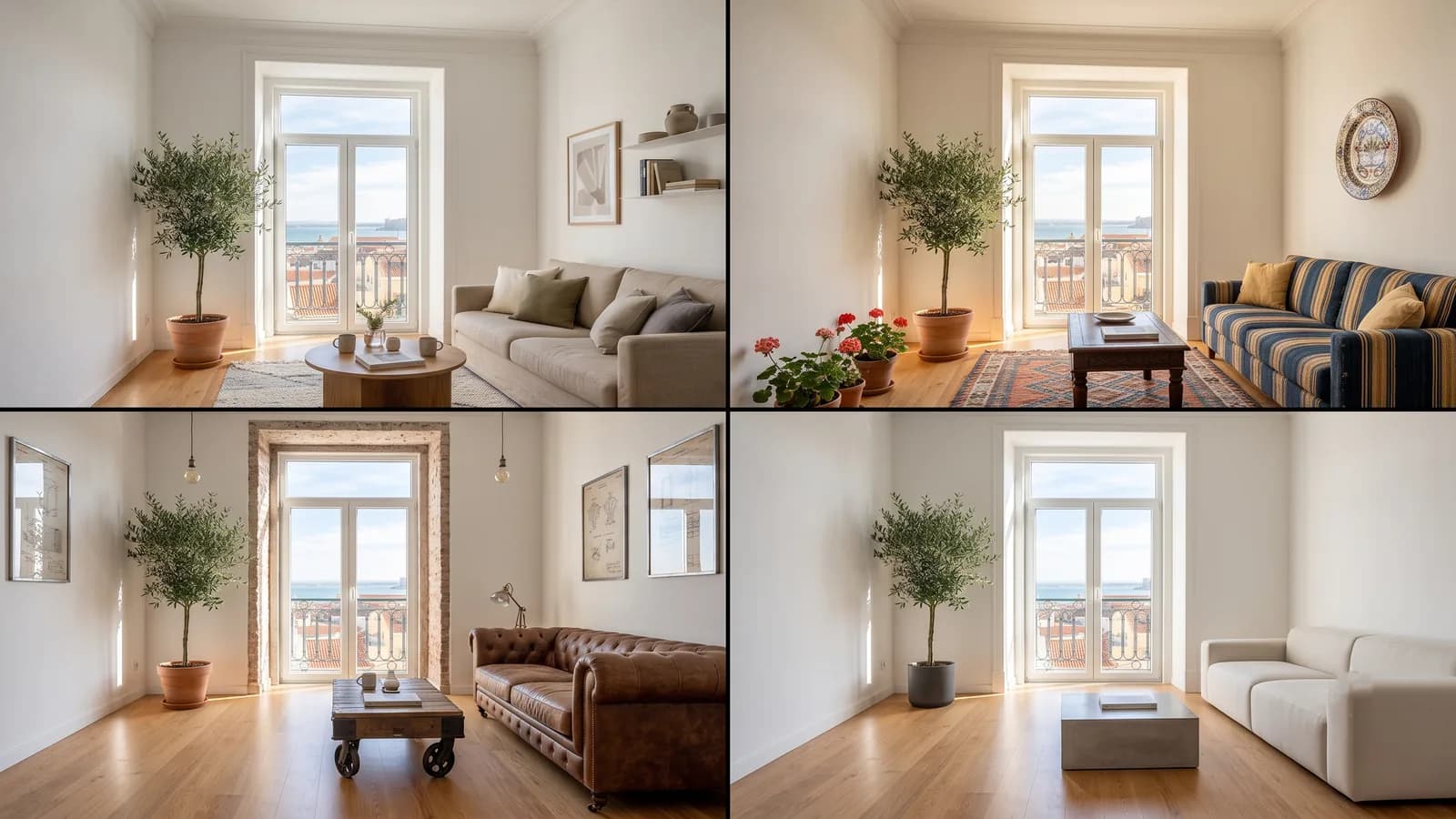
Virtual staging is the practice of digitally furnishing a property photograph. The definition is simple. The implications for how agents present listings, how buyers experience them, and how quickly properties sell are not.
This guide is the complete reference on the subject. It covers the history, the technology, the business case, the legal framework, the different types of properties where staging works best, how to choose a tool, how to disclose correctly, and how to integrate it into a listing workflow that produces results.
What Is Virtual Staging?
Virtual staging is the process of using software to insert photorealistic furniture, décor, lighting, and finishing elements into a photograph of an empty or poorly furnished room. The output is a high-resolution image that shows the space furnished and styled, without any physical furniture entering the property.
Modern virtual staging uses AI — specifically, machine learning models trained on architectural photography — to perform this process automatically from a single photograph. The agent uploads an image, selects a style, and receives a furnished version of the room in under two minutes. No design skills required. No coordination with a staging company. No logistics.
What virtual staging is not
Virtual staging is not rendering. 3D rendering builds an image from scratch using modelling software and architectural data. Virtual staging works from a real photograph.
Virtual staging is not photo editing. Traditional photo editing requires a human operator to manually composite 3D furniture assets into a photograph, a process that takes hours per image and costs significantly more.
Virtual staging is not AI image generation in the general sense. General-purpose AI image generators — tools like Midjourney — create images based on text descriptions with no reference to a real physical space. Virtual staging AI analyses a real photograph and produces a furnished version of that specific space.
A Brief History
Virtual staging as a commercial service first appeared around 2005, when designers began manually placing digital furniture assets into property photographs using early versions of compositing software. The results were rudimentary, the process was slow, and the cost — typically $200 to $500 per room — was prohibitive for most of the market. It remained a niche service used almost exclusively for luxury properties.
Between 2010 and 2018, dedicated virtual staging companies emerged with proprietary 3D furniture libraries and standardised workflows. Costs dropped to $50 to $100 per room. Turnaround times shortened to 24 to 48 hours. Quality improved substantially. Adoption grew, particularly in the US and UK markets.
The AI transition began in earnest around 2022, when advances in diffusion models — the same technology underlying image generation tools — made it possible to stage a room automatically from a photograph without human designer involvement. The first AI staging tools were imperfect, prone to geometric errors and inconsistent quality. Between 2023 and 2025, the quality gap between AI and human-edited staging closed rapidly.
By 2026, the market has matured into a clear structure: a small number of AI-first platforms that produce listing-ready quality reliably and at scale, a tier of human-edited services for edge cases and luxury listings, and the remnant physical staging industry for the specific situations where it still makes economic sense.
How It Works — The Technology
Scene analysis
The AI receives a photograph and begins by analysing the physical space it depicts. It identifies the room's structural elements — walls, floor, ceiling, windows, doors, built-in features — and calculates the three-dimensional geometry of the space from the two-dimensional image. It assesses perspective, vanishing points, proportional relationships between elements.
Simultaneously, it analyses the lighting conditions: the position and intensity of natural light sources, the colour temperature of the ambient light, any artificial lighting present, and how existing surfaces (floor, walls, ceiling) reflect and absorb light.
Spatial modelling
Using the scene analysis data, the AI builds an internal model of the physical space. This model is the constraint that governs all subsequent decisions. Furniture placement, scale, shadow direction, and material rendering all flow from this spatial model. Platforms that build this model accurately produce images where everything is proportionally and geometrically correct. Platforms that approximate or skip this step produce the inconsistencies that make images look artificial.
Style application
The agent selects an interior style — Modern, Scandinavian, Mediterranean, Luxury, Industrial, Minimalist, and others depending on the platform. The AI draws from a curated library of furniture and décor matched to that style and places pieces within the spatial model. The placement reflects standard residential furniture arrangements: sofas facing entertainment areas, dining tables centred under ceiling fixtures, beds aligned with room axes.
Rendering
Shadow and light interactions between the placed furniture and the existing scene are calculated and rendered. Material textures — fabric grain, wood tone, glass reflectivity — are generated at a resolution appropriate for the final output. The image is delivered in 4K.
The Business Case for Virtual Staging
Impact on listing click-through rates
The most direct measurement of staging impact is what happens to listings on portals after staging is applied. The data across markets is consistent: staged listings generate 90% more clicks than unstaged equivalents in the same search category. On Idealista, Imovirtual, or Rightmove, where buyers are scrolling through grids of thumbnail images, a staged photo generates approximately twice as many clicks as an empty room in the same grid position.
Impact on time on market
The Real Estate Staging Association's data shows staged properties sell 73% faster than unstaged equivalents. The average reduction in time on market is 20 to 30 days. In markets where buyer confidence is sensitive to how long a property has been listed — and most markets are — this reduction has compounding value. A property that sells in 3 weeks does not generate the buyer suspicion that a property listed for 10 weeks does.
Impact on sale price
Multiple studies show virtually staged homes achieve asking prices 5 to 10% higher than comparable unstaged properties. NAR research shows 81% of buyers report it is easier to visualise themselves living in a professionally staged home. The cognitive ease of imagining life in the space translates directly to stronger emotional commitment and less aggressive price negotiation.
The real cost comparison
The conversation about staging costs almost always focuses on the cost of staging. The more important calculation is the cost of not staging.
On a property priced at €400,000, every week on the market without an offer increases the risk of a price reduction. A 2.5% price reduction to close a stalled sale is €10,000. The virtual staging that prevented the stall cost €3 for three images. This is not a marginal calculation. It is the financial case for making virtual staging standard practice across every listing in a portfolio.
Virtual Staging Styles — The Complete Guide
Modern
Clean, contemporary lines. Neutral tones — white, off-white, warm grey — with simple, functional furniture and minimal decoration. This is the default style for urban apartments, new builds, and properties targeting professional buyers or investors. It reads as current without being trend-specific, which gives it a long shelf life.
Scandinavian
Light wood tones, muted palettes, functional furniture with soft textile accents. The warmest of the contemporary styles and the one with the broadest demographic appeal. Works particularly well for family properties, suburban locations, and mid-market residential. The style communicates comfort, practicality, and a certain everyday livability that resonates with buyers who are buying a home rather than an investment.
Mediterranean
Warm clay and terracotta tones, natural stone and ceramic surfaces, an implied connection to outdoor living. The right choice for coastal properties, villas, country houses, and holiday homes across southern Europe. It sells the lifestyle — the light, the warmth, the relationship between inside and outside — not just the square metres. International buyers purchasing in Portugal, Spain, or southern France respond very strongly to this style.
Luxury
Rich materials, statement furniture, layered lighting. Dark marble surfaces, deep velvet or leather upholstery, brass and gold hardware, curated artwork. For premium and high-end properties where the visual language needs to communicate quality and exclusivity. This style is easily misused: applying a luxury staging to a mid-market property creates a disconnection that buyers sense immediately, even if they cannot articulate it. Match the staging register to the price register of the property.
Industrial
Exposed textures — brick, concrete, raw metal — combined with warm wood elements and statement lighting. Suited to lofts, warehouses in conversion, properties with exposed structural elements, and urban spaces with strong architectural character. The buyer profile is design-conscious, typically younger, and is buying the character of the space as much as the space itself.
Minimalist
Almost nothing in the frame. The minimalist approach is about restraint: a single sofa, a low coffee table, one carefully chosen piece of art. It works for small apartments where adding too much furniture makes the space feel claustrophobic, and for architecturally interesting properties where the design of the space should take precedence over the staging.
Matching style to property
The decision should be driven by two factors: the type of property and the profile of the most likely buyer. A Mediterranean coastal villa staged in a clinical Modern style sends the wrong signal. An urban T2 staged in a Mediterranean style looks confused. The style is a communication tool, and it communicates most effectively when it is consistent with what the buyer is already imagining.
When Virtual Staging Works Best
Empty properties
The fundamental use case. An empty room offers nothing for a buyer to connect with. Scale is impossible to judge, function is unclear, and the emotional response — which is what actually drives the decision to visit — is absent. Staging provides all three things immediately.
Properties with dated interiors
Heavy furniture, dark colour schemes, and aged décor are among the most common reasons well-located properties with good bones underperform on portals. The AI decluttering tool removes the existing furniture digitally, and the staging replaces it with a contemporary interior. The owner does not move or change anything in the physical property.
New build and off-plan
Developers marketing apartments during or before construction use virtual staging to show buyers the finished, furnished apartment before it exists. Multiple style variants from the same photo set allow different buyer profiles to be targeted simultaneously.
Stalled listings
A listing that has been active for three or more weeks without generating visits has an awareness problem that a staged photo refresh often resolves. The portal algorithm typically resets the listing's position when photos are updated, improving its visibility in search results at the same time the presentation improves.
Rental relisting
Landlords relisting between tenancies can use previously staged photos for subsequent listings, provided the property has not changed significantly. At under €2 per listing for the initial staging, the cost is justified even for short-term rental properties.
Legal Compliance and Disclosure
The universal requirement
Virtual staging is accepted on all major European portals — Idealista, Imovirtual, Rightmove, Immoscout24, SeLoger — and is legal in all major real estate markets. The universal requirement is that staged photos must be disclosed as such.
Standard disclosure language
The most widely accepted formulation:
"Images include virtual staging for illustrative purposes. The property is delivered unfurnished."
This note in the listing description is sufficient for compliance on most European portals. In markets with specific regulatory requirements for digital alterations — several US states now have explicit rules — additional labelling may be required.
What you cannot do
Virtual staging cannot be used to misrepresent the physical property. Adding windows or structural features that do not exist, altering apparent room dimensions, or concealing defects or damage crosses from staging into misrepresentation, regardless of disclosure. The purpose of staging is to present the space's potential. The purpose is never to deceive.
The counterintuitive truth about disclosure
Disclosure does not reduce listing performance. A Zillow study showed disclosed staging generates 15% higher trust scores in post-visit surveys. Buyers who were informed about the staging arrive at visits with accurate expectations. Buyers who were not informed feel deceived when the reality differs from the photos. Disclosure is not a concession — it is a professional standard that protects everyone involved.
Getting Started
Stageless AI processes the first image free, with no credit card required. Three free credits are available on signup. The platform is browser-based and requires no software installation.
Start with one underperforming listing, apply staging to the main rooms, republish, and measure enquiry volume for the following two weeks. The comparison is almost always sufficient to make the adoption decision. Start at stageless.ai.
Start free at stageless.ai — first image in under 2 minutes, no subscription required.
Written by Stageless Team
We are a team of real estate technology experts passionate about AI. Our mission is to help agents sell faster by democratizing access to high-end virtual staging tools.

