

Virtual Staging for Real Estate: The Complete 2026 Guide

Stageless Team
Editor in Chief
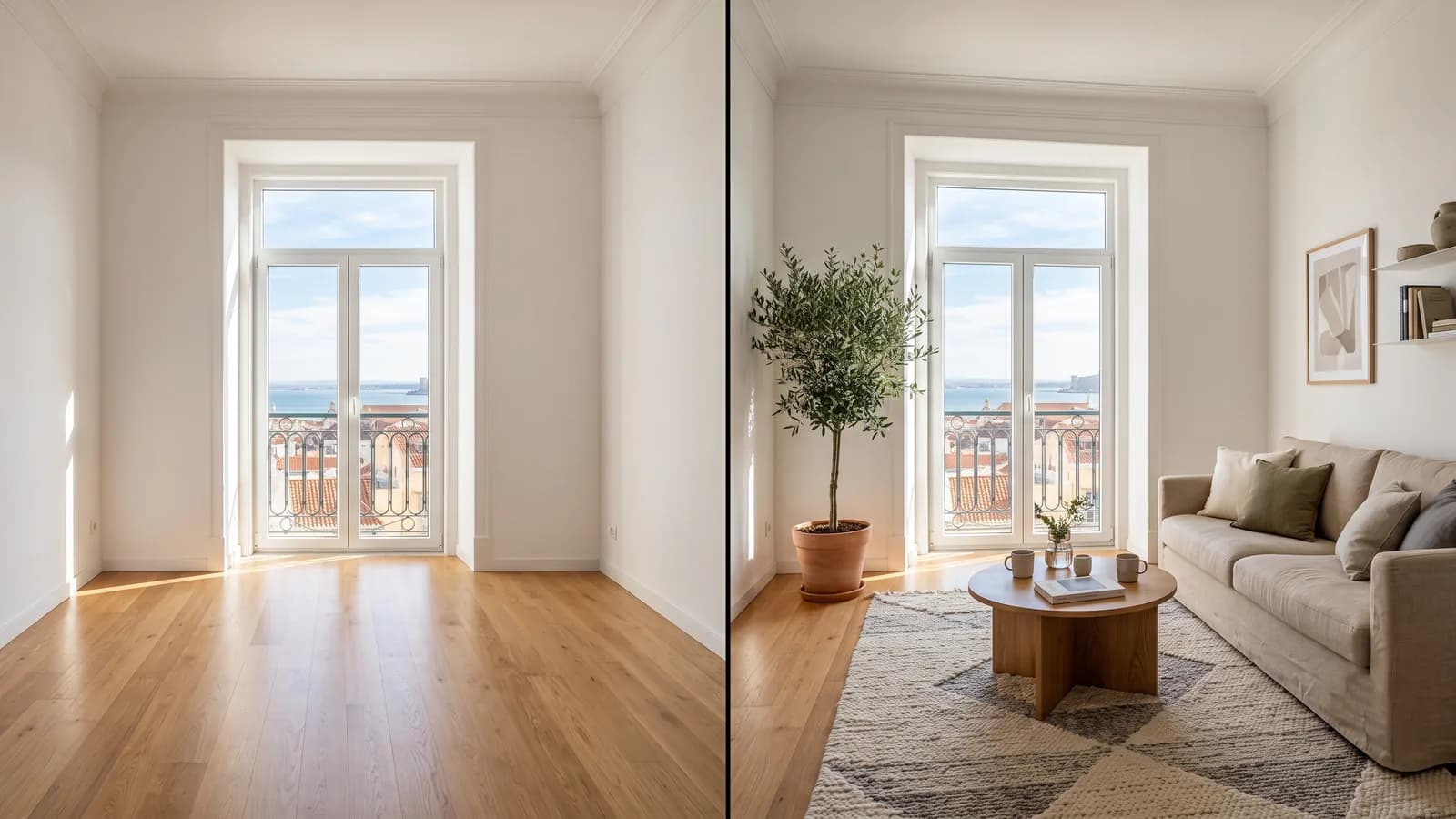
Virtual staging is now the default presentation standard for competitive listings on Idealista, Imovirtual, Rightmove, and Zillow. Agents who still publish empty rooms are handing a measurable advantage to every competitor in the same price range. This is not a trend that is still emerging — it has already happened. The agents who adopted it early are seeing it in their numbers. The ones who haven't are seeing it in their days on market.
This guide covers everything you need to know: how virtual staging works, what it costs, how to use it correctly, when it makes sense and when it doesn't, and what the data actually says about its impact on listing performance.
What Is Virtual Staging?
Virtual staging is the process of digitally furnishing a property photo. You upload a photograph of an empty or poorly furnished room, and software inserts photorealistic furniture, décor, rugs, lighting, and artwork directly into the image — without touching the property and without any physical furniture entering the space.
The result is a high-resolution photograph that shows the room furnished, styled, and ready for buyers — delivered in under two minutes, from a browser, at a fraction of the cost of traditional staging.
It is worth being precise about what virtual staging is not, because the category gets confused with related tools. It is not 3D rendering. It is not computer-generated imagery built from a floor plan. It works from a real photograph of the actual property, which means the proportions, natural light, existing architecture, and spatial relationships are preserved exactly as they are in the physical space. What the buyer sees is the real room, with digital furniture placed inside it.
Virtual staging vs. traditional home staging
Traditional home staging involves hiring a company to source real furniture, transport it to the property, arrange it for a photo shoot, and remove it afterwards. In Portugal and Spain, this process typically costs between €1,500 and €6,000 per property depending on size and how many rooms need to be staged. In the UK, costs range from £2,000 to £8,000. The process takes between five and ten business days from booking to photo shoot completion.
Virtual staging produces a result that is visually comparable in listing photos — and with modern AI tools, often indistinguishable to buyers — at €0.60 to €15 per image, in under two minutes. For most of the market, that comparison ends the debate.
Virtual staging vs. CGI renders
CGI renders are built entirely in 3D modelling software. They do not start from a real photograph — they construct an image from scratch using architectural drawings or floor plans. This makes them useful for developers marketing properties before construction is complete, where no physical space yet exists to photograph. But they are expensive, slow to produce, and require significant technical expertise.
Virtual staging starts from a real photograph. The underlying space is real. The furniture is digital. The distinction matters because buyers trust photographs more than renders, and because virtual staging preserves the actual character of the space — the way light falls through a specific window, the texture of a real floor, the proportions of an actual room — in a way that a render cannot replicate.
Why Virtual Staging Matters More in 2026 Than It Did Two Years Ago
The case for virtual staging is not new. Agents have been aware of the concept for years. What has changed in 2026 is the combination of three factors that have made adoption effectively unavoidable for any agent who wants to compete seriously.
Buyers complete most of their decision-making process online
Research from the National Association of Realtors shows that buyers in 2026 browse an average of 12 listings online before scheduling a single in-person visit. The decision to visit — which, in a competitive market, is also implicitly a decision to make an offer — is made almost entirely based on photographs. An empty room gives a buyer nothing to connect with emotionally. It does not answer the questions that matter: Does the sofa fit? Is there enough natural light? Can I picture my family here? A furnished room answers all of these questions before the buyer has to form them consciously.
Most listings still go to market empty or poorly presented
Despite years of data on staging performance, the majority of listings across European markets still go live with empty rooms, dated furniture, or photos taken in poor lighting conditions. This is an opportunity. In a portal feed where most properties are not staged, the ones that are staged stand out immediately. The agents who stage consistently are not competing on the same terms as those who don't.
The cost barrier has been eliminated
The reason most agents did not stage all of their listings historically was economics. Physical staging at €3,000 per property makes sense for a €500,000 apartment but not for a €150,000 flat. AI virtual staging at €0.60 per image eliminates that calculation entirely. Every listing at every price point can now be presented to a professional standard.
How AI Virtual Staging Works
The technology behind modern virtual staging AI is more sophisticated than the simple workflow suggests. Understanding how it works helps explain why quality varies so dramatically between platforms.
Scene analysis
The AI begins by analysing the photograph to understand the physical space it is working with. This involves identifying walls, floor surfaces, ceiling height, window positions, doorways, and any existing objects in the frame. It calculates the perspective — the camera angle, the vanishing points, the relationship between vertical and horizontal elements. It assesses the existing light sources: where natural light enters the room, how it behaves on different surfaces, what colour temperature it produces.
This analysis is what separates architecture-aware virtual staging tools from generic AI image generators. Tools that skip or oversimplify this analysis produce images that look impressive in a thumbnail and fall apart under examination — furniture at the wrong scale, shadows falling in the wrong direction, windows that appear to have moved between the original photo and the staged version.
Geometry mapping
Using the scene analysis, the AI builds a spatial model of the room. This model determines how furniture will be placed: at what scale, in what position, with what relationship to the walls and floor. A sofa placed against a wall needs to sit on the actual floor surface of the image, at the correct proportional size relative to the room, with its shadow falling in the direction consistent with the existing light source.
The geometry mapping step is what makes the difference between a staged image that looks like a real photograph and one that looks artificial. When a buyer looks at a virtually staged image and something feels slightly wrong — the room looks slightly off, a piece of furniture doesn't quite fit — it is almost always a geometry problem rather than a style or quality problem.
Style application and rendering
The AI selects furniture, décor, and materials from the chosen style library and composites them into the spatial model. Shadows are calculated relative to the existing light sources. Material textures — fabric grain, wood tone, glass reflectivity — are rendered at a resolution that holds up at 4K. The final image is upscaled and delivered as a standard image file.
The entire process runs in under 90 seconds on Stageless AI.
Virtual Staging Styles — Choosing the Right One for Each Property
The style you select for a virtual staging is not a matter of personal preference. It is a strategic decision that affects which buyers respond to the listing. Applying the wrong style to a property does not just fail to attract the right buyer — it can actively repel them by creating a disconnect between the visual language of the staging and the reality of the space.
Modern
Clean lines, neutral tones, contemporary furniture with minimal ornamentation. The right choice for urban apartments, new build properties, and city centre locations. The buyer this style speaks to is a young professional, an investor, or a couple without children who wants a space that feels current and uncluttered.
Scandinavian
Light wood tones, muted off-white and grey palettes, functional furniture with warm textile accents — linen cushions, wool throws, natural fibre rugs. The most broadly appealing style for mid-market residential properties. It works for families, first-time buyers, and anyone who wants a home that feels warm without being heavy.
Mediterranean
Warm terracotta and clay tones, natural stone textures, ceramics, an implied connection to outdoor living. The correct choice for coastal properties, villas, country houses, and holiday homes in southern Europe. International buyers searching for property in Portugal, Spain, or southern France respond to this style because it signals the lifestyle they are buying into.
Luxury
Statement furniture, rich materials — marble, deep wood tones, heavy fabrics — and layered lighting. For high-end and premium-segment properties where the visual language needs to signal quality and exclusivity. Important: applying a luxury style to a mid-market property does not make the property look more expensive. It makes the staging look disconnected from the reality of the space, which undermines trust.
Industrial
Exposed brickwork, metal elements, open sightlines, concrete surfaces alongside warm wood accents. Suited to converted spaces, lofts, warehouses converted to residential use, and properties with exposed structural elements. Attracts design-conscious buyers who are looking for character rather than conventional residential presentation.
Minimalist
Almost nothing in the frame. A single sofa, a low coffee table, one piece of art. The style signals space, calm, and restraint rather than lifestyle. It works well for small apartments and studios, where adding too much furniture makes the space feel smaller and more claustrophobic. It is also effective for properties with strong architectural features that should not be competed with.
Matching style to property and location
A useful rule: the staging style should match what the target buyer is already dreaming about. A buyer looking at a beach apartment in the Algarve is dreaming of a Mediterranean lifestyle. Staging that apartment in a grey Scandinavian palette sells against the dream instead of with it. A buyer looking at a T2 in Lisbon's Mouraria wants to feel the character of the neighbourhood in the space. A clinical luxury staging feels imported and wrong.
The Business Case — What the Data Says
The performance data on virtual staging across markets is consistent enough that the question has shifted from "does it work?" to "why aren't you doing it for every listing?".
Impact on listing click-through rates
Staged listings generate 90% more clicks on portal searches than equivalent unstaged listings, according to data compiled from Zillow, Rightmove, and Idealista performance metrics. On a portal where hundreds of listings are competing for the same buyer's attention, a 90% increase in clicks is the difference between a listing that works and one that sits.
Impact on time on market
Properties with professional staging sell 73% faster than comparable unstaged listings on average. The Real Estate Staging Association puts the reduction in market time at 20 to 30 days for residential properties. On a property priced at €300,000, 25 fewer days on the market is not just a matter of convenience — it is a measurable reduction in the probability of a price negotiation.
Impact on sale price
Virtually staged homes achieve asking prices 5 to 10% higher than comparable unstaged properties on average, according to data from multiple market studies. 81% of buyers say it is easier to visualise living in a home when it is professionally staged.
The cost-of-not-staging calculation
Most agents calculate the cost of staging. Almost none calculate the cost of not staging.
On a property priced at €350,000, a 3% price reduction to close a sale that has stalled is €10,500. The three virtually staged photos that might have prevented the stall cost €1.80.
The staging is not a marketing cost. It is risk management against a far larger potential loss.
Use Cases — Which Properties Benefit Most
Empty residential properties
The clearest and most common use case. An empty room without furniture gives buyers no reference for scale, function, or lifestyle. They cannot tell whether the bedroom fits a double bed, whether the living room accommodates a family sofa, whether the kitchen feels functional. Virtual staging answers all of these questions immediately. Properties that have been sitting on the market without generating enquiries despite reasonable pricing and location are almost always a presentation problem, and this is the fastest available fix.
Occupied properties with outdated furniture
Heavy, dark, or dated furniture is one of the most consistent reasons a listing underperforms. Modern buyers see renovation costs rather than potential. The combination of AI decluttering — which removes the existing furniture digitally — and virtual staging, which replaces it with a contemporary interior, transforms the presentation without asking the current owner to move a single piece of furniture or vacate the property.
Off-plan and new build developments
Developers marketing properties before or during construction use virtual staging to show the potential of the space in sales materials, portal listings, and social media. The advantage over CGI renders is realism and flexibility: starting from the actual architectural photographs produces images buyers trust more, and different style variants can be generated from the same base image to target different buyer profiles.
Properties that have stalled
A listing that has accumulated weeks on the market without generating visits or enquiries has a credibility problem that a price reduction typically makes worse. Buyers see a property that has been sitting and assume there is something wrong with it. Updating the photos with virtual staging and republishing — in some cases with a minor price adjustment — resets the listing's perceived freshness and often restarts enquiry volume.
Commercial spaces in reconversion
Former office or retail spaces being converted to residential use often photograph in a way that makes it very difficult for buyers to understand the residential potential. The space looks like an office because it is one. Virtual staging applied to architectural photos of the empty space, showing it furnished as an apartment, helps buyers understand the scale, function, and character of the finished product.
Disclosure — The Legal and Ethical Framework
Virtual staging is legal and accepted on all major European and North American real estate portals. The universal requirement across markets is transparency.
What you must disclose
Every listing that includes virtually staged photos must make this clear in the listing description. The standard formulation accepted across Idealista, Imovirtual, Rightmove, and other major portals is:
"Images include virtual staging for illustrative purposes. The property is delivered unfurnished."
Some portals have dedicated metadata fields for digitally enhanced photos; where these exist, they should be completed in addition to the description note.
What virtual staging cannot be used for
Adding architectural features that do not exist — windows, rooms, structural elements. Altering the apparent dimensions of rooms to make them appear larger. Concealing visible defects or damage to surfaces or fixtures. These uses constitute misrepresentation regardless of whether disclosure is provided, and they generate liability for the agent.
Why disclosure builds rather than undermines trust
A 2025 Zillow study found that listings with clearly labelled virtual staging generated trust scores 15% higher in post-visit buyer surveys than listings where staging was not disclosed. Buyers who know the photos include staging arrive at visits with accurate expectations about the condition of the space. Buyers who were not informed, and who find the property does not match the impression created by the photos, feel misled — and that affects their willingness to proceed.
Disclosure is not a formality that costs you clicks. It is a standard that protects both the buyer and the agent, and the data shows it does not reduce listing performance.
How to Integrate Virtual Staging into Your Listing Workflow
The agents who get the most value from virtual staging are the ones who treat it as a standard step in the listing process rather than an optional extra for certain properties.
The workflow in practice
Photograph the property as you normally would. For empty rooms, standard listing photography technique applies. Upload the photos to Stageless AI from your browser — no software installation, compatible with desktop and mobile. Select the style that matches the property type and target buyer. Download the 4K staged images. Add the disclosure note to the listing description. Publish.
For a standard three-bedroom apartment, the entire staging process — from first upload to download of the final images — takes under 15 minutes.
Starting with underperforming listings
If you are new to virtual staging and want to test the impact before committing to it as a standard workflow step, start with one listing that has been generating consistent impressions but few click-throughs or enquiries. Apply staging to the main spaces, update the portal photos, and track enquiry volume over the following two weeks. The comparison between before and after is almost always enough to confirm the decision.
Combining with exterior staging
Interior staging addresses the photos buyers see after they open the listing. Exterior staging addresses the cover photo that determines whether they open it at all. In most listings, the cover photo is an exterior shot. The full presentation workflow — interior staging for the main rooms, exterior staging for the cover photo — takes the same time as interior staging alone and dramatically improves the listing's click-through performance at the portal level.
Getting Started with Stageless AI
Stageless AI offers three free credits on signup, with no credit card required. The platform is browser-based and works on desktop and mobile. First image from upload to download takes under two minutes.
The recommended starting point: take one photo from a current listing that is underperforming, run it through the platform, and compare the output against what is currently published. Start at stageless.ai.
Try it free at stageless.ai — no subscription, no credit card. First staged image in under 2 minutes.
cada um. Prontos para publicar por ordem de prioridade do GSC.
Written by Stageless Team
We are a team of real estate technology experts passionate about AI. Our mission is to help agents sell faster by democratizing access to high-end virtual staging tools.

