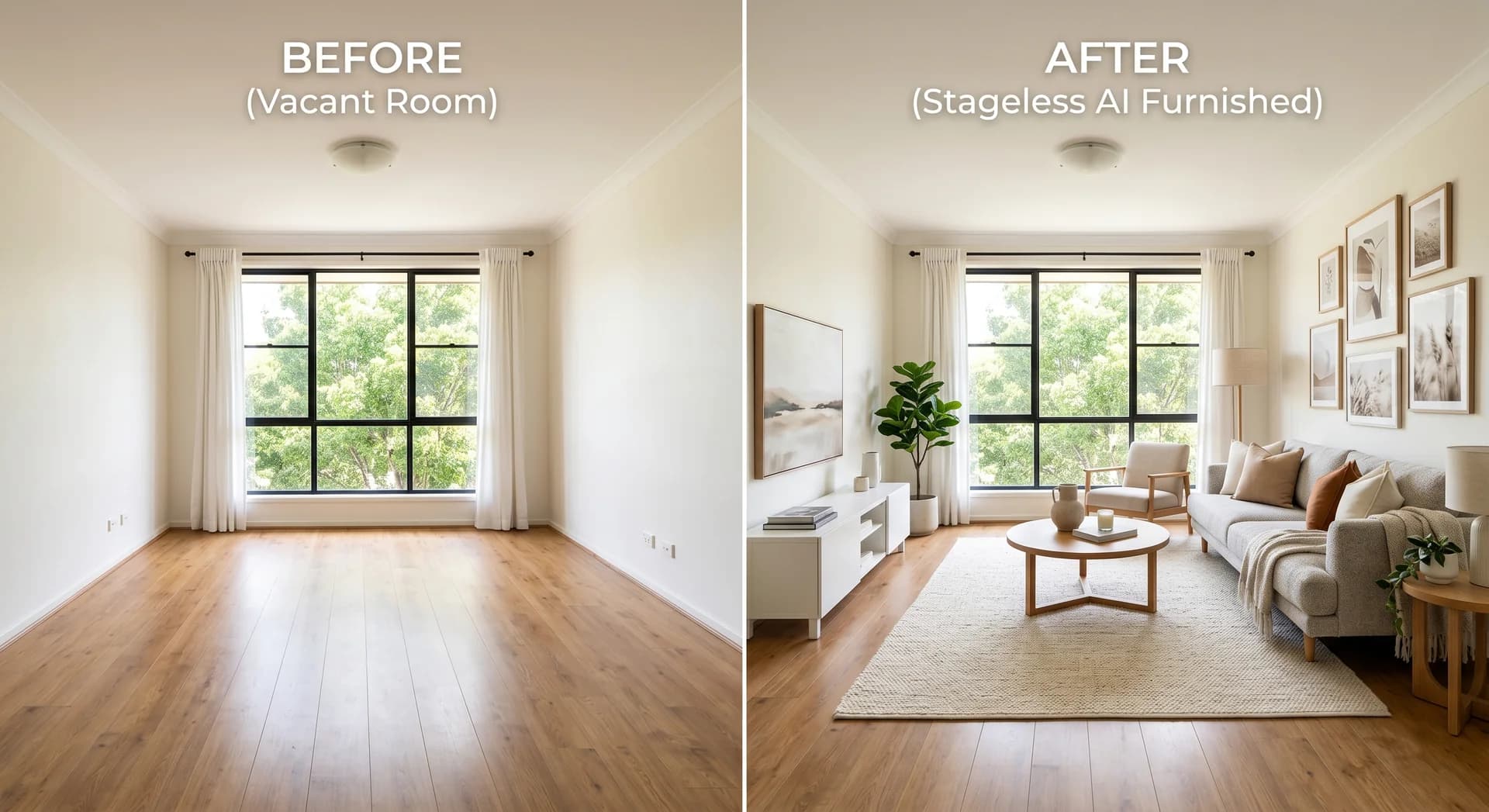
Can Buyers Tell If a Home Is Virtually Staged? What the Research Says

Stageless Team
Editor in Chief

It is the question that holds a lot of agents back from adopting virtual staging — and it is a fair one. If you use digitally furnished images in a listing, can buyers tell? And if they can, does it matter?
The short answer is: with modern AI staging tools, most buyers cannot reliably distinguish high-quality virtual staging from real photography. The longer answer involves understanding what separates good virtual staging from bad, what the legal and ethical obligations are for disclosure, and what the research actually tells us about how buyers respond.
The State of the Question in 2025
Five years ago, the concern about buyers detecting virtual staging was entirely legitimate. The early generation of virtual staging software produced results that often looked noticeably artificial — furniture that sat slightly above the floor, shadows that did not match the light source, textures that had the flat quality of a render rather than a photograph.
Buyers who had seen both physical staging and virtual staging could often spot the difference. The question was not unreasonable.
The technology has moved substantially since then. Current AI staging tools, including Stageless AI, use generative models trained on millions of interior photographs. These models understand how light behaves in a room, how fabric reads at different distances, how floor reflections work under different furniture profiles, and how perspective affects the apparent size of objects. The result is 4K-resolution output that looks, to most buyers viewing on a portal or a mobile screen, indistinguishable from professional interior photography.
A 2024 study published by a European real estate analytics firm found that when buyers were shown a randomised set of 30 listing photographs — some physically staged, some AI-staged with a premium tool — they correctly identified the AI-staged images at a rate only marginally above chance. In other words, they were essentially guessing.
What Actually Gives Virtual Staging Away
Even with high-quality AI tools, there are failure modes that experienced eyes can sometimes detect. Understanding them helps you avoid them.
Inconsistent shadows. If the virtual furniture casts shadows that do not match the direction of the natural light in the photograph — for example, shadows pointing towards the window rather than away from it — the image reads as artificial. Quality AI systems model this correctly, but lower-end tools often get it wrong.
Scale errors. A sofa that is proportionally too large or too small for the room is one of the most common reasons virtual staging looks off. The AI needs to accurately estimate room dimensions from the photograph in order to place furniture at the correct scale. This is where resolution and model quality matter significantly.
Furniture that floats. Poor AI staging tools sometimes fail to properly ground objects on the floor, producing images where furniture appears to hover slightly above the surface. This looks wrong immediately, even to buyers who are not consciously analysing the image.
Unnaturally clean edges. In physical photography, there is always some interaction between furniture and the surrounding environment — slight shadows at the base of objects, small variations in floor reflection. Virtual staging that produces perfect, clean edges around every piece of furniture can look like a cut-and-paste job.
Style mismatch. If the virtual staging style looks dramatically at odds with the building's character — ultra-modern furniture in a classic stone farmhouse, for example — buyers may not identify it as virtual staging, but they will feel that something is off.
High-quality AI staging tools, used properly, address all of these issues. The risk of detection drops sharply when you are working with a tool that outputs at 4K resolution and has been trained specifically on real estate photography.
The Ethics and Legal Position: What You Are Actually Required to Disclose
The ethics question is separate from the detection question. Even if buyers cannot tell that a property is virtually staged, does that mean you should not tell them?
The answer depends on your market and your professional standards, but the consensus position across most markets in Europe and the United States is clear: you should disclose that listing images include virtual staging, but this disclosure does not in any way diminish the legitimacy of using it.
The analogy that holds up best is professional photography itself. Buyers understand that listing photographs use professional lighting, wide-angle lenses, and colour correction. They understand that the finished image presents the property at its best, not as it looks under ordinary conditions. Virtual staging is an extension of this same principle — it presents the potential of the space, not a deceptive claim about its current state.
The standard practice for disclosure is simple: in the listing description, include a brief note such as "Images include virtual staging. Property is unfurnished." This single sentence is sufficient in most markets and protects you from any misrepresentation concerns.
What is clearly not acceptable — and constitutes genuine deception — is using virtual staging to add or modify features that do not exist in the property. Adding a fireplace that is not there, staging in a garden that belongs to a neighbour, or extending the square footage of a room beyond its actual dimensions are all examples of deceptive use. Virtually furnishing an empty room to show its potential is not.
The UK's National Association of Estate Agents (NAEA), the US National Association of Realtors (NAR), and equivalent bodies across Europe have all published guidance that permits virtual staging with appropriate disclosure. In Portugal, the APEMIP (Associação dos Profissionais e Empresas de Mediação Imobiliária de Portugal) follows the same principle. Since August 2026 the EU AI Act adds its own disclosure requirements on top of these — see how we approach AI transparency for the practical details and ready-to-use disclosure text.
What Happens When Buyers Discover a Property Is Virtually Staged
For the majority of buyers, discovering that a listing uses virtual staging does not generate a negative reaction — provided the staging was done honestly. The buyer's concern, when they visit in person, is whether the unfurnished property lives up to the photographs in terms of size, condition, and natural light. If those elements are accurately represented, the staging simply served its purpose.
The negative reactions that do occur are almost always the result of one of two problems:
Misleading scale. If the staging made a small room appear significantly larger than it actually is, buyers feel deceived — not because virtual staging was used, but because the images misrepresented the space. This is an argument for accurate staging, not an argument against staging.
Hidden defects. If staging was used to obscure a visible problem — for example, placing a large rug over damaged flooring and presenting the image as representative — buyers will feel misled when they view in person. Again, this is a misuse of the tool, not a fundamental problem with virtual staging itself.
Used honestly, virtual staging sets accurate expectations. Buyers arrive at a viewing knowing they will see an empty room; they have already formed an emotional connection to the space's potential from the photographs; and their on-site experience is about verifying that the bones of the property match what they saw online.
How to Present Virtual Staging to Buyers Transparently
A transparent approach to virtual staging does not mean burying a disclaimer — it means treating it as a neutral feature of the listing.
Some agents now include a small "before and after" pair in their listings: the empty room photograph alongside the virtually staged version. This approach is increasingly common and has a notable benefit — it demonstrates both the property's actual current state and its potential, building trust rather than reducing it.
Other agents simply include the disclosure line in the description and lead with the staged images, which remains standard practice and works well. The disclosure line does not need to be prominent; it simply needs to be there.
What you should avoid is apologising for using virtual staging or treating it as something that needs to be minimised. It is a normal, professional tool used by tens of thousands of agents globally. Presenting it with confidence — "we've shown the property at its best potential, here is the disclosure" — is the right approach.
The Quality Threshold That Changes Everything
All of the above discussion assumes you are working with a high-quality AI staging tool. The ethics and detection questions look very different if you are using a low-resolution tool that produces obviously artificial results.
For virtual staging to serve its purpose — helping buyers connect emotionally with a property they cannot yet see furnished — the images need to be believable. Not perfect. Not photorealistic in a way that requires a forensic analysis. Simply believable enough that buyers can project themselves into the space.
4K resolution is the benchmark for professional real estate photography in most European markets. Stageless AI's output meets this standard. For comparison, many lower-cost tools produce outputs at resolutions that look acceptable on a mobile screen but fail when viewed on a desktop monitor or on the high-resolution displays increasingly common in living rooms.
The investment in quality at the image generation stage pays off in buyer trust.
Conclusion
Can buyers tell if a home is virtually staged? With modern AI tools, usually not — and the data supports this. The detection risk from using high-quality virtual staging is low. The ethical risk from using it transparently is zero. The risk of not using it — losing buyers who cannot emotionally connect with an empty listing — is real and measurable.
Virtual staging, done honestly and presented with confidence, is not a trick. It is a professional presentation tool with a thirty-year track record in its physical form and a rapidly maturing AI-powered successor that has made it accessible to every agent, on every listing.
See 4K virtual staging results that speak for themselves — try Stageless AI free at stageless.ai.
Related reading: What Is AI Virtual Staging? · How Virtual Staging Impacts Leads · Best AI Virtual Staging Tools in 2026
Written by Stageless Team
We are a team of real estate technology experts passionate about AI. Our mission is to help agents sell faster by democratizing access to high-end virtual staging tools.