Virtual Staging vs Physical Staging: Cost, Time, and ROI Compared (2026)

Stageless Team
Editor in Chief

Virtual Staging vs Physical Staging: Costs, Time, and Sales Impact
In real estate marketing, visual presentation is the engine that drives leads. When preparing a listing, agents face a critical question: should they invest in traditional physical homestaging, or opt for virtual staging solutions? The choice directly impacts profit margins, time-on-market, and how a property performs on platforms like Zillow, Rightmove, Idealista, and other major portals.
At Stageless AI, we work with thousands of agents who have moved from physical to virtual staging — and a smaller number who continue to use both. This article breaks down the real cost, time, and ROI tradeoffs based on data from 2025-2026, so you can choose the right strategy for your portfolio.
The Cost Comparison: What Each Method Actually Costs in 2026
Physical Staging Cost Breakdown
Physical home staging is a logistically complex service. Even a basic staging job involves multiple suppliers and recurring fees. According to Investopedia, professional home staging costs typically range from $2,000 to $5,000 per property, with luxury listings reaching $10,000-$20,000. The line items typically include:
- Furniture rental: €1,500-€3,500 per month, depending on the size of the property and the quality tier of furniture.
- Moving and installation: €300-€800 for a single move-in, plus a similar charge for move-out.
- Interior designer fees: €500-€1,500 for the initial consultation and styling plan.
- Professional photography after staging: €300-€800 for a full property shoot.
- Storage and damage insurance: often bundled into the rental contract but can add 5-15% to the total.
- Property access coordination: hidden time cost for the listing agent or property manager.
For a typical 90 m² apartment listing in Western Europe, the all-in cost of physical staging usually lands between €2,500 and €4,500 per month. If the property doesn't sell in the first month, those costs continue compounding. For the full line-item breakdown by city and property size, see real physical staging prices in 2026.
AI Virtual Staging Cost Breakdown
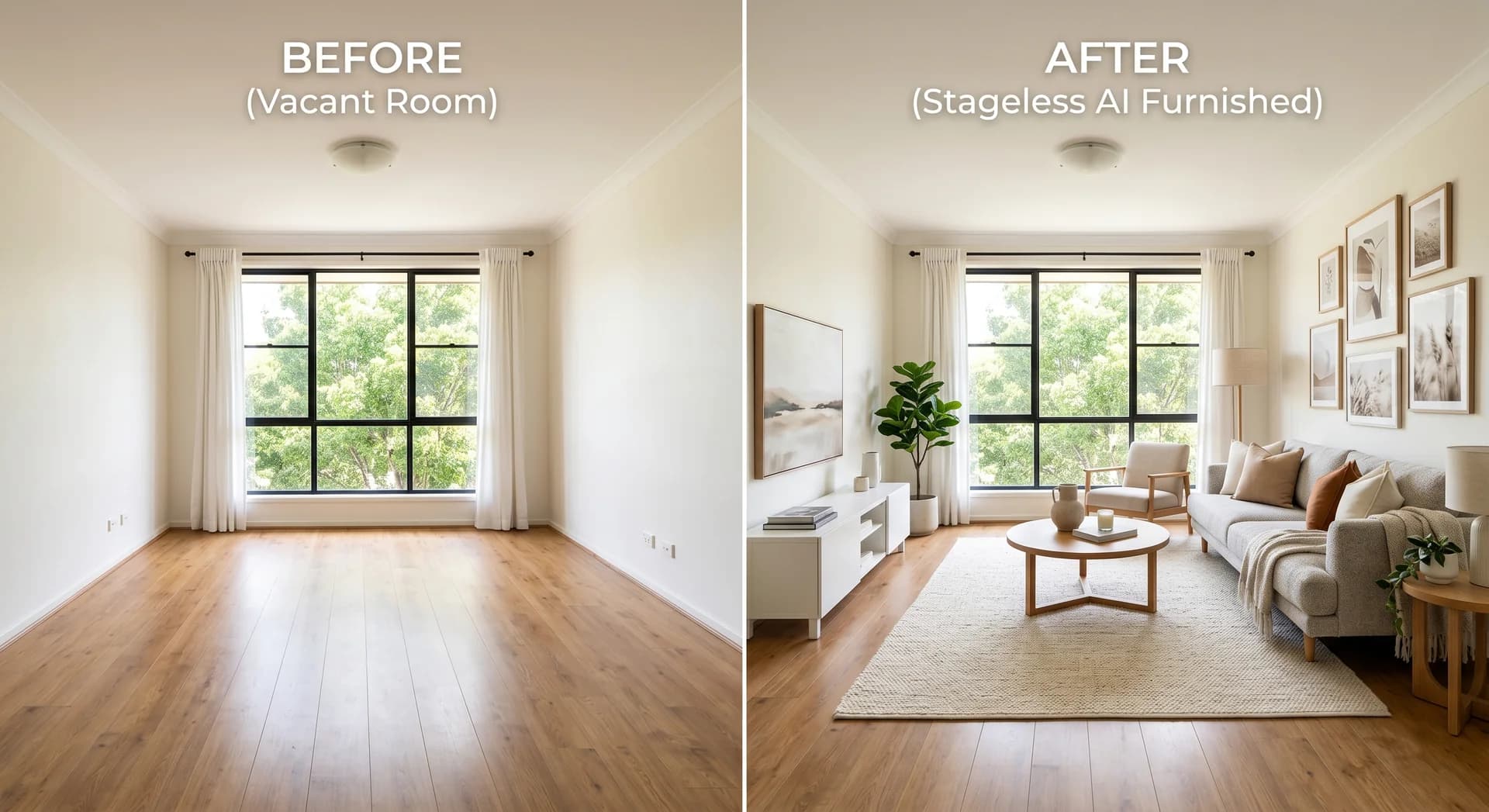
The AI virtual staging cost structure is dramatically simpler. With Stageless AI, you pay a flat €0.60 per image. There is no rental period, no logistics fee, no designer cost, and no follow-up shoot required — the original photo is the input.
For a typical 12-photo listing, the math looks like this:
- Photo capture (one-time): €100-€300 with a real estate photographer, or €0 if shot in-house.
- AI virtual staging (12 photos): €7.20.
- Optional add-ons: decluttering, image enhancement, or text-based edits, each at €0.60 per photo.
Total for a fully staged, decluttered, and enhanced 12-photo listing: roughly €25-€30 in AI processing, against €2,500+ for physical equivalent. The cost reduction is 95%+ for the marketing production stage of the listing process.
Time and Logistics: From Listing to Live
The Physical Staging Cycle (7-15 Days)
Preparing a home physically takes between one and three weeks. The typical sequence:
- Day 1-3: Initial property visit by the staging consultant; planning the layout and furniture style.
- Day 4-7: Furniture sourcing and scheduling the moving crew.
- Day 8-10: Move-in day; assembly and styling on-site.
- Day 11-12: Professional photography session.
- Day 13-15: Post-production editing, final delivery, listing publication.
During those 7-15 days, the property sits in inventory limbo. The seller is paying mortgage, utilities, and opportunity cost on a property that isn't actively earning leads. For a luxury listing, those carrying costs alone can run into the thousands per week.
The AI Virtual Staging Cycle (Under 5 Minutes)
With Stageless AI, the same workflow takes minutes. Once the photos are captured (or even shot from a smartphone in good lighting), the entire production pipeline is digital:
- Upload the raw photos to the dashboard.
- Select a design style (Modern, Scandinavian, Industrial, Coastal, Mediterranean).
- Generate. The AI delivers 4K-quality renders in seconds.
- Review, optionally apply object removal or instruction-based edits.
- Download and publish to your portal.
The total elapsed time, from raw photo to live listing, is typically under 30 minutes. For agents juggling dozens of listings per month, this speed advantage compounds into a structural competitive advantage.
Visual Quality and Design Versatility
One of the often-overlooked advantages of virtual staging is design versatility. With physical staging, you commit to one furniture style for the duration of the staging contract. If the property doesn't attract the right buyer, switching styles requires a full move-out, move-in, and re-shoot — costing thousands of euros and delaying the listing further.
With Stageless AI, the same room can be virtually staged in five different styles in five minutes for €3.00 total. Agents commonly publish listings with two or three style variants — a Modern version for younger buyers, a Classic version for retirees, a Family-oriented version for couples with children — and let buyer engagement metrics show which version drives more inquiries.
This kind of A/B testing is functionally impossible with physical staging. With AI, it's the new default.
Architectural Integrity
A common concern with AI staging tools is architectural distortion: walls that bend, windows that disappear, ceilings that warp. Stageless AI was specifically engineered to address this. Our architectural integrity feature ensures that the structural elements of the room (walls, windows, doorways, ceilings, floors) are preserved exactly as they appear in the original photo. The staging adds furniture and decor without altering the geometry, which is critical for both buyer trust and portal compliance.
Lead Generation and Sales Impact
Cost and speed matter, but the ultimate question is: does virtual staging generate as many leads as physical staging? Industry data from 2025-2026 says yes — and in some categories, virtual outperforms physical.
- Click-through rate (CTR): Listings with high-quality virtual staging show similar CTR to physically staged listings, both significantly above unstaged baseline.
- Time on market: Both staged categories sell 30-50% faster than unstaged equivalents.
- Sale price: Industry surveys consistently report a 1-5% sale price premium for staged properties versus unstaged, across both methods.
- Lead quality: Virtually staged listings tend to attract slightly more qualified leads due to the lifestyle-targeting flexibility (different style versions for different buyer profiles).
The upside of virtual staging isn't that it produces dramatically better leads than physical staging — it's that it produces equivalent results at 5% of the cost and 1% of the time investment.
When Physical Staging Still Wins
To be balanced: there are still niche cases where physical staging is the right call. These include:
- Open houses: If buyers will physically visit the property and the open-house experience itself is the conversion event, real furniture matters. Most agents handle this with a hybrid approach: virtual staging for online photos, light physical staging (a few key pieces) for in-person viewings.
- Ultra-luxury listings ($5M+): Buyers in this segment expect a fully realized in-person experience. Physical staging communicates seriousness and budget alignment.
- New developments with on-site sales centers: Show-flat staging in a sales center is its own marketing investment, separate from listing photos.
For the vast majority of listings — typically 90-95% of an average agency's portfolio — virtual staging is the obvious economic choice.
The Hybrid Approach: Best of Both Worlds
Many sophisticated agents use a hybrid workflow that captures the benefits of both methods. The pattern looks like this:
- Shoot the property in its current state (vacant, occupied, or cluttered).
- Use AI decluttering and AI virtual staging for online listings, generating multiple style variants for A/B testing.
- For physical viewings, add minimal "presentation staging" — typically a few key items (a couch, a dining table, a bedroom set) selected based on the AI variant that performed best online.
- Avoid full physical staging; use the data-driven minimal version instead.
This approach reduces the physical staging budget by 70-80% while preserving the in-person viewing experience that some luxury buyers expect.
ROI Calculation: A Concrete Example
Consider a 110 m² apartment listed at €450,000. Two scenarios:
Scenario A — Physical Staging: €3,500 staging cost + €600 photography + 14 days of preparation. Total upfront cost: €4,100. Time-to-listing: 14 days.
Scenario B — AI Virtual Staging: €0 in-house photo capture + €30 in AI processing (12 photos staged + decluttered + enhanced) + 1 day of preparation. Total upfront cost: €30. Time-to-listing: 1 day.
If both scenarios produce equivalent lead generation (which industry data supports), Scenario B saves €4,070 per listing and reclaims 13 days of marketing exposure. For an agent doing 30 listings per year, that's €122,100 in saved costs and 390 days of recovered listing time — a transformational improvement to agency economics.
Conclusion: Which is the Best Choice for Your Business?
For 95% of real estate listings in 2026, virtual staging is the clear economic winner. It costs 95% less, delivers in 1% of the time, and produces equivalent or better lead generation outcomes. Physical staging retains a niche role in ultra-luxury and open-house-driven listings, but the default workflow for modern agents has shifted decisively to AI tools.
Stageless AI gives you the entire toolkit: virtual staging, decluttering, object removal, image enhancement, and text-based editing — all delivered in 4K, all priced at €0.60 per image. Sign up at Stageless AI and stage your first photo today.
Written by Stageless Team
We are a team of real estate technology experts passionate about AI. Our mission is to help agents sell faster by democratizing access to high-end virtual staging tools.