Home Staging Virtual: How It Works & 2026 Pricing

Stageless Team
Editor in Chief
Home staging virtual is one of those terms that means slightly different things to different people depending on their market background. For agents in Portugal and Spain, it is the familiar phrase for a service that is changing how properties are presented and sold. For agents in the UK and US, "virtual staging" is more common. The tools, the process, and the outcomes are the same — only the terminology differs.
This guide covers the concept completely: what home staging virtual is, how the technology works, what the data says about its impact, what it costs, and how to use it without running into legal or ethical problems.
What Is Home Staging Virtual?
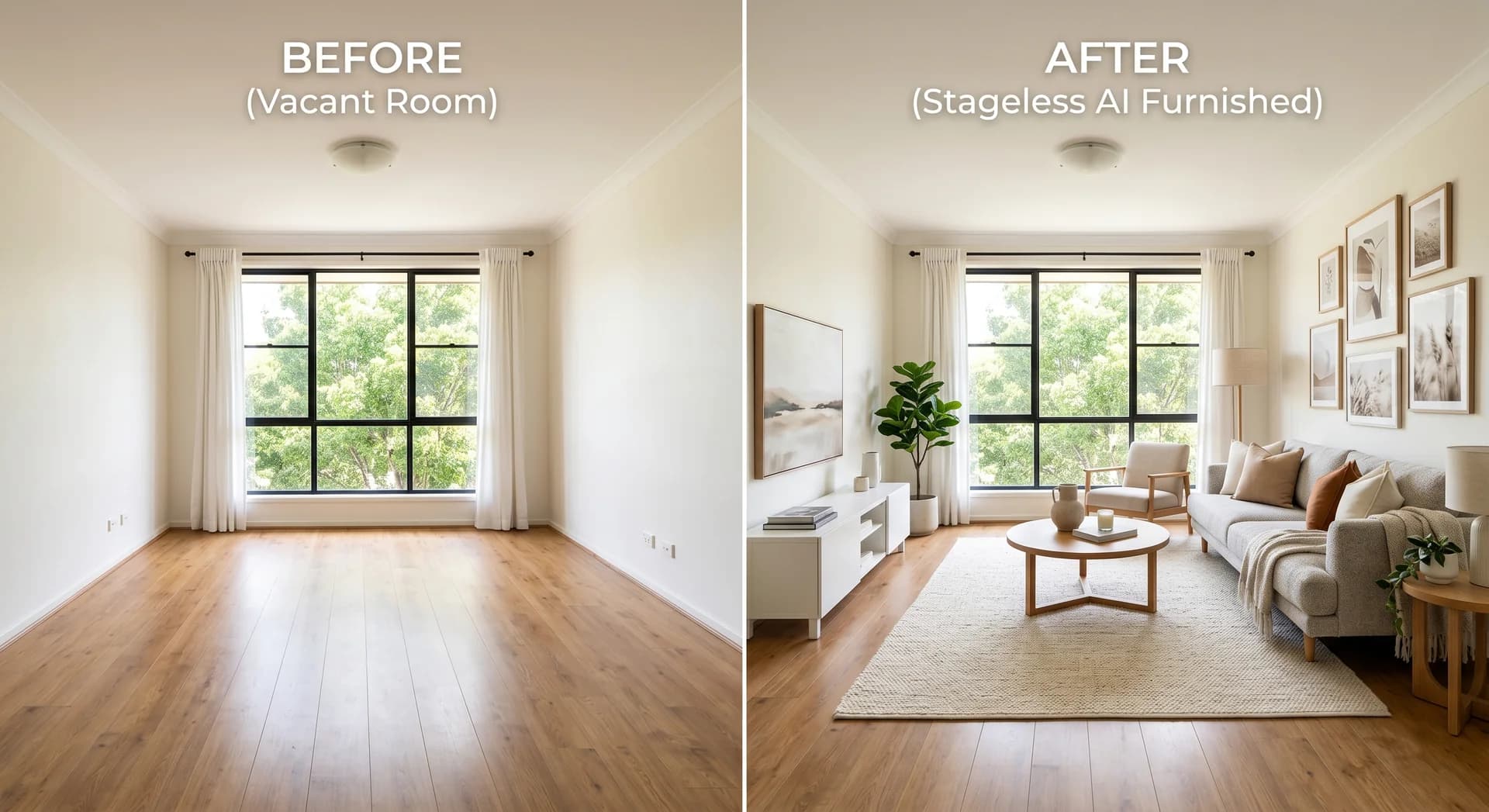
Home staging virtual is the process of digitally furnishing property photographs. An AI tool takes an image of an empty or poorly furnished room and inserts photorealistic furniture, décor, lighting, and finishing touches directly into the photograph — without any physical furniture entering the property, without hiring a staging company, and without coordinating a logistics operation.
The output is a high-resolution image that shows the space furnished and styled, ready for publication on real estate portals. The process takes under two minutes. The cost starts at €0.60 per image.
The difference from traditional home staging
Traditional home staging is a physical service. A company sends a team to the property with real furniture — sofas, dining tables, beds, artwork, rugs, plants — arranges the space for professional photography, and then removes everything after the shoot. In the Portuguese and Spanish market, the cost typically runs between €1.500 and €6.000 per property depending on the number of rooms and the level of finish. The logistics take between five and ten days.
Home staging virtual replaces the physical furniture with digital furniture, the logistics team with an AI model, and the five-to-ten day process with a two-minute workflow. The output — a photograph of a furnished room — is functionally identical in the context of a portal listing.
The difference from CGI renders
CGI renders are photographs of rooms that do not yet exist. They are built entirely in 3D modelling software, typically for developers marketing off-plan properties before construction is complete. The process is expensive and technically demanding.
Home staging virtual starts from a real photograph of the actual space. The room already exists. The AI adds furniture to the photograph of the real room, rather than building a fictional room from scratch. This distinction matters because photographs of real spaces are more trusted by buyers than renders, and because the actual character of the space — the natural light, the proportions, the texture of the surfaces — is preserved.
Why Home Staging Virtual Has Become Standard Practice
Five years ago, virtual staging was used by a minority of agents for specific property types. Today it is standard practice for any agent who wants to compete seriously on the major portals. The shift happened because three things changed simultaneously.
Buyer behaviour moved online permanently
Research from the National Association of Realtors shows that 97% of buyers now use the internet at some stage in their property search. More importantly, most of the actual decision-making — which properties to visit, which to dismiss — happens online before any in-person viewing takes place. Buyers browse 12 listings on average before scheduling a visit. The listing photo is not a supplement to the physical visit. For most buyers, it is the primary evaluation tool.
Portal competition intensified
On Idealista or Imovirtual, a buyer searching for a T2 in Lisbon between €250,000 and €350,000 might be looking at 80 to 200 results. Their attention moves through those results fast. An empty room has a few seconds to establish itself as worth clicking. A well-staged room is at minimum twice as likely to generate a click. In a competitive portal feed, that difference compounds into a substantial advantage.
The cost came down to where it is impossible to justify not using it
The historical objection to virtual staging was cost. Physical staging at €3,000 per property was a genuine barrier for mid-market agents. When AI virtual staging arrived at €0.60 per image, the economic objection disappeared. The cost of staging every listing is now lower than the cost of printing three flyers.
How Home Staging Virtual Works — A Technical Overview
Understanding how the AI produces staged images helps clarify why quality varies so much between platforms, and why the choice of tool matters for professional use.
Scene understanding and geometry analysis
The first thing a virtual staging AI does when it receives an image is analyse the physical space in the photograph. It identifies walls, floor surfaces, ceiling height, windows, doorways, and any existing objects. It calculates the perspective — the camera angle, the vanishing points — to understand the three-dimensional geometry of the room from a two-dimensional image.
This geometry analysis is what determines whether the finished image is convincing or not. Furniture placed in a room must sit on the actual floor surface, at the correct proportional scale relative to the architectural elements, with shadows that fall in the direction of the existing light sources. Tools that skip or simplify this analysis produce furniture that floats slightly above the floor, sofas that are slightly too large or too small, and shadows that fall in impossible directions. These errors are often felt rather than consciously identified by buyers, but they erode trust.
Style matching and furniture placement
Once the geometry is understood, the AI selects furniture from the chosen style library and places it into the spatial model of the room. The selection is not random — the model understands standard furniture arrangements for residential spaces and places pieces in positions that reflect how people actually use rooms. A sofa faces the television wall. A dining table is centred under the light fixture. A bed is aligned with the room's dominant axis.
Light and shadow integration
The furniture placed in the scene must integrate with the existing lighting conditions of the photograph. A room lit from a window on the left wall casts shadows towards the right. The furniture placed in that room must cast consistent shadows. The materials must show the effect of the light — a linen sofa near a window should have brighter fabric facing the light and shadow on the opposite side.
This is where AI staging tools diverge most clearly from generic image generators. A tool trained specifically on architectural photography understands lighting physics. A general-purpose image model does not.
4K rendering and delivery
The final image is rendered at full resolution — typically 4K — and delivered as a standard JPEG or PNG file. The process from upload to download runs in under 90 seconds on Stageless AI.
The Step-by-Step Workflow
Step 1 — Photograph the property
Photograph the property as you normally would for a listing. Empty rooms produce the best results, but tools like Stageless AI can also declutter photographs of occupied spaces before staging — removing existing furniture digitally and then applying the staged interior. Use a wide-angle lens if available, shoot in good natural light, and keep the camera level to ensure accurate perspective in the output.
Step 2 — Select and upload your photos
Open Stageless AI in your browser — no software installation required, works on desktop and mobile. Upload the photos you want to stage. You can stage multiple photos in a single session, which is the most efficient approach for a full listing.
Step 3 — Choose a staging style
Select the interior style that best matches the property type, location, and target buyer profile. Available styles include Modern, Scandinavian, Mediterranean, Industrial, Minimalist, and Luxury. If you are staging multiple rooms in the same property, use the same style throughout for visual consistency.
Step 4 — Download and review
The staged image is delivered in 4K in under two minutes. Review it for quality — check that furniture proportions are accurate, that shadows are consistent, and that the room looks like a real photograph. If you want to adjust a specific element without regenerating the entire image, Stageless AI's Edit with Instructions feature lets you describe the change in plain language: "change the sofa colour to dark grey", "remove the floor lamp on the right", "add a lighter rug under the coffee table".
Step 5 — Add disclosure and publish
Add the standard disclosure note to the listing description: "Images include virtual home staging for illustrative purposes. The property is delivered unfurnished." Upload the staged photos to the portal and publish.
The Performance Data
The impact of home staging virtual on listing performance has been documented across multiple markets and is consistent.
Click-through rates
Staged listings generate 90% more clicks on portal search results than unstaged equivalents. On Idealista or Imovirtual, where a buyer searches a category and sees a grid of thumbnail photos, a staged image generates approximately twice as many clicks as an empty room in the same grid position. This is the most direct measure of staging impact because it reflects actual buyer behaviour at the moment of decision.
Time on market
Properties presented with professional staging sell 73% faster than unstaged equivalents, according to the Real Estate Staging Association's 2026 data. The reduction in market time averages 20 to 30 days for residential properties. In a market where each week of additional exposure increases the probability of a price reduction request, a 20-day reduction in time on market is a financially significant outcome.
Enquiry quality
Buyers who have engaged with well-staged listing photos arrive at visits more prepared and more decided. They have already formed a visual impression of the space living in it; the visit confirms what they have already imagined rather than introducing the concept for the first time. This changes the nature of the conversation at the door and reduces the frequency and intensity of objection-based negotiation.
The buyer perception data
81% of buyers say it is easier to visualise living in a property when it is professionally staged (NAR, 2026). This is the foundational insight behind all staging — not that it makes properties look more expensive, but that it reduces the cognitive work buyers have to do to imagine themselves in the space. The less cognitive work required, the faster the decision.
Home Staging Virtual for Specific Property Types
Vacant T2 and T3 apartments in urban centres
The most common and highest-ROI application. An empty apartment that has been generating impressions on Idealista without generating clicks is almost always a presentation problem. Staging the living room, main bedroom, and kitchen — three photos at under €2 total — addresses the core issue at minimal cost. For properties in urban centres where there are dozens of comparable listings, staging is the fastest available differentiator.
Occupied properties where the current furniture damages presentation
Properties where the current resident's furniture is heavy, dated, or visually dominant are among the most difficult to photograph well. The AI decluttering tool removes the existing furniture from the photograph, and the virtual staging replaces it with a contemporary interior. The owner does not need to move anything, vacate the property, or coordinate a staging team. The entire process happens digitally, in under five minutes per room.
Off-plan and new build developments
Developers using home staging virtual to show unfurnished completed apartments — or properties still under construction — benefit from the ability to show the finished space furnished in multiple styles from a single architectural photograph. A developer with 30 identical T2 units can generate six style variants per apartment without any additional photography.
Holiday and seasonal properties
Coastal villas, country houses, and holiday apartments in tourist destinations benefit from staging that signals the lifestyle the buyer is purchasing. A holiday property on the Algarve coast staged in a Mediterranean style — warm tones, natural materials, light and space — sells the experience, not just the square metres. Buyers searching for holiday properties respond to emotional triggers more strongly than buyers searching for primary residences.
Properties in the portfolio that have been listed for more than four weeks
Any property that has been active for more than four weeks without generating visits deserves a presentation review before a price reduction is considered. In the majority of cases, the problem is the photos. Updating them with virtual staging, republishing, and resetting the listing's position in portal algorithms costs under €10 and takes under 20 minutes.
Common Questions
Do I need a professional photographer for home staging virtual to work?
Professional photography produces better base images and better staging outputs. However, modern AI staging tools — including Stageless AI — are capable of working with high-quality smartphone photographs. The critical factors are natural light (shoot in daylight, avoid mixed lighting), a level camera (distorted perspective makes the geometry analysis less accurate), and a clean space (empty rooms produce better results than rooms with items left on floors or surfaces).
How many rooms should I stage per listing?
NAR research identifies the living room, master bedroom, and kitchen as the three spaces that most influence buyer decisions. Staging these three rooms covers the majority of the impact at the lowest cost. For properties where the dining room or a second bedroom is a significant feature, adding those rooms increases cost from €1.80 to €3.00.
Can I use the same staged photos for multiple listings of the same unit?
Yes. Developers relisting units that have not yet sold can reuse staged photos indefinitely, provided the underlying property has not changed. Landlords can reuse staged photos across consecutive rental listings for the same property.
What happens if the property is sold and the buyer expects it to be furnished?
This is precisely why disclosure is required. The listing description must specify that the photos include virtual staging and that the property is delivered unfurnished. A buyer who proceeds on this basis has been informed and has no grounds for complaint. A buyer who was not informed has a legitimate grievance.
Pricing Overview
| Service | Cost | Turnaround |
|---|---|---|
| Stageless AI (pay-as-you-go) | From €0.60 per image | Under 2 minutes |
| Stageless AI (monthly plan) | From €20/month | Under 2 minutes |
| Designer virtual staging | €15 – €50 per image | 1–3 business days |
| Full-service virtual staging company | €50 – €150 per image | 2–5 business days |
| Physical staging | €1,500 – €6,000 per property | 5–10 business days |
Getting Started
Stageless AI offers three free credits on signup. No credit card required. The platform works from any browser on desktop or mobile. Start at stageless.ai, upload a photo from one of your current listings, select a style, and download the result. The entire process from account creation to staged image download takes under five minutes for most users.
Start with 20 free credits at stageless.ai. No subscription required.
Written by Stageless Team
We are a team of real estate technology experts passionate about AI. Our mission is to help agents sell faster by democratizing access to high-end virtual staging tools.