How to Get More Leads from Your Real Estate Listings in 2026

Stageless Team
Every agent knows the feeling. A property sits on the market for three weeks, the phone stays quiet, and the seller starts asking uncomfortable questions. The listing is not bad. The price is not obviously wrong. But the leads are not coming.
In most cases, the problem is not the property. It is the presentation.
Buyers in 2026 make their first decision about a property in under eight seconds — the time it takes to scroll past a listing on Rightmove, Zillow, or Idealista. That first impression is almost entirely visual. Before they read the price, before they check the square footage, before they look at the location on a map, they have already decided whether to click or keep scrolling.
This article covers the tactics that actually move the needle on lead generation — not abstract advice about understanding your market, but specific, implementable changes that affect what buyers see when they encounter your listings online.
The single most important variable: your hero photograph
Real estate portals rank listings partly by click-through rate. A listing that gets clicked more gets shown more. A listing that gets shown more generates more leads. The entire chain starts with one image: the hero photograph that appears in search results.
Research published by the National Association of Realtors found that 95% of buyers use the internet in their home search, and that the quality of listing photographs is the single factor most likely to determine whether a buyer requests a viewing. Not the price. Not the description. The photographs.
The implications are significant. An agent who invests twenty minutes improving their listing photographs is not doing aesthetic work — they are doing lead generation work.
What constitutes a strong hero photograph? Several things: natural light, a wide shot that shows the room's scale, a clear sightline that draws the eye into the space, and — critically — a furnished room rather than an empty one.
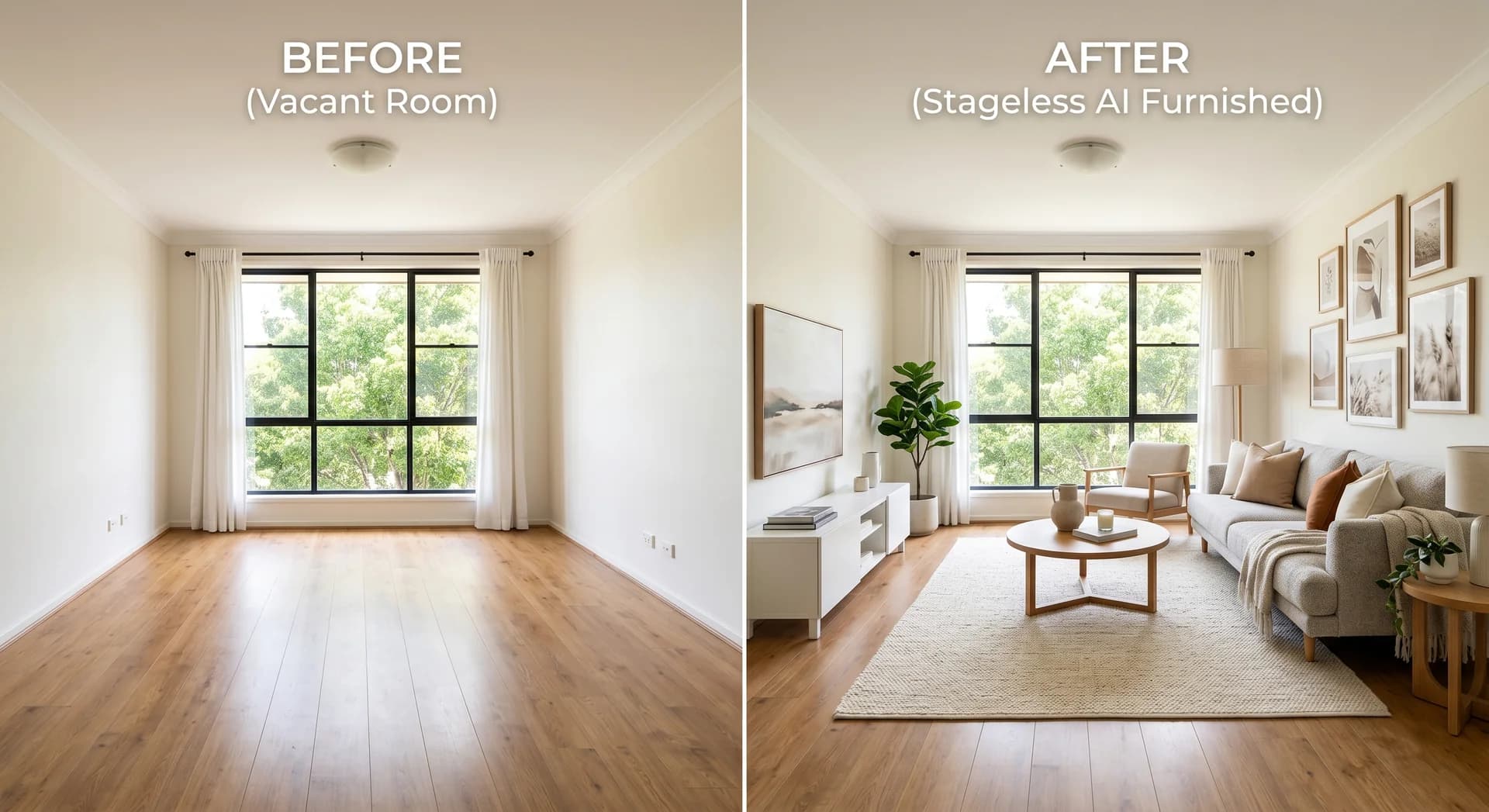
Empty rooms perform consistently worse than furnished ones on property portals. Buyers struggle to gauge scale without furniture as a reference, and an empty room generates no emotional response. It documents a space rather than selling a home. According to data from the Real Estate Staging Association, staged homes spend 73% less time on the market than unstaged ones, and listings with staged photographs receive significantly higher click-through rates on portals. For the full breakdown by portal, see our 2026 portal lead data.
Virtual staging: how to furnish any room without moving anything
Until recently, staging meant physically moving furniture into a property — a process that cost between €2,000 and €5,000 for a typical apartment and required days of coordination. For vacant properties or properties where physical staging was impractical, agents were stuck with empty room photographs.
AI virtual staging has changed this entirely.
Tools like Stageless AI allow agents to upload an empty room photograph and receive a fully furnished, photorealistic 4K image in under 30 seconds. The AI analyses the room's geometry, light sources, and floor plane, then generates furniture that is correctly scaled, lit, and shadowed to match the physical reality of the space. The result is indistinguishable from professional interior photography for the vast majority of buyers viewing on a standard screen.
The cost is €0.60 per photograph. A five-room listing can be fully staged in under 20 minutes at a total cost of under €15.
For agents who regularly work with vacant properties — new builds, investment properties, inherited homes — virtual staging eliminates the single largest barrier to producing compelling listing photographs. The property does not need to be furnished. It does not need to be occupied. It needs to be photographed, and the AI does the rest.
For occupied properties with cluttered or dated interiors, the process runs in two steps: the AI Declutter tool removes existing furniture and personal items first, then the staging tool furnishes the cleaned room in a chosen style.
Fix your photography before you spend anything else
Virtual staging is only as good as the underlying photograph. Before investing in any other listing improvement, it is worth understanding the most common photography mistakes that suppress lead generation.
Poor lighting. The most common problem. Photographs taken without professional lighting — or taken at the wrong time of day — produce dark, contrasty images that make rooms look smaller and less appealing than they are in person. If professional photography is not possible, photograph at midday with all lights on and all windows unobstructed.
Wrong focal length. Smartphone cameras default to a focal length that distorts rooms. A wide-angle lens — typically 16–24mm on a full-frame camera — produces the rectilinear perspective that makes rooms look their actual size. Shooting from a corner of the room, at chest height rather than eye height, typically produces the most flattering result.
Cluttered foregrounds. Estate agents often overlook what is in the foreground of a shot. A radiator cover, a pile of post on a table, a child's toy — any object in the foreground draws the eye and reduces the perceived size of the room.
Too many photographs. Counter-intuitively, more photographs do not always mean more leads. A tightly edited gallery of eight to twelve strong photographs — covering all key rooms plus the exterior — tends to outperform a thirty-image gallery that includes every angle of every room.
Optimise your listing text for the way buyers actually read
Most listing descriptions are written in a way that assumes buyers read them carefully. They do not. Eye-tracking studies of portal behaviour consistently show that buyers scan listings in an F-pattern: they read the first line, skim the beginning of subsequent lines, and rarely reach the end of a long paragraph.
What this means in practice is that the most important information must appear in the first sentence. Not the second. Not after a long preamble about the property's location or history. The first sentence.
For a three-bedroom apartment in Lisbon, the first sentence might be: "A fully renovated three-bedroom apartment in Santos, 400 metres from the river, with a south-facing terrace." Everything the buyer needs to decide whether to keep reading is in that sentence — size, condition, location, and a distinguishing feature.
After the first sentence, use short paragraphs of two to three sentences maximum. Each paragraph should address one room or one aspect of the property. Avoid estate agent clichés — "stunning," "immaculate," "must-see" — which buyers filter out automatically. Specific details are far more persuasive than adjectives.
Portal algorithms also index listing text for keywords. Terms like "home office," "storage," "parking," "south-facing," and "lift" consistently appear in high-volume buyer searches. If a property has these features, they should be stated explicitly in the listing text — not implied or mentioned only in passing.
Price your listing to generate enquiries, not to anchor negotiations
Pricing strategy affects lead volume more directly than most agents acknowledge. A property priced at €495,000 will appear in more portal searches than one priced at €500,000, because many buyers set their search ceiling at round numbers. The difference in exposure can be significant — portal data from Rightmove has shown that listings priced just below round-number thresholds receive meaningfully higher click volumes.
The more common pricing mistake is overpricing at launch. A property that enters the market above fair value generates low initial enquiry, accumulates days on market, and typically sells for less than it would have if priced correctly from the start. Buyers and their agents notice how long a property has been listed. A listing that has been on the market for sixty days raises questions that a fresh listing does not.
The optimal pricing approach for lead generation is to price at or slightly below the market's natural equilibrium for the property type and location — ideally below a round-number threshold — and to review within fourteen days based on enquiry volume. A price that generates five or more enquiries per week is probably correctly positioned. One that generates fewer than two should be reviewed.
Use your listing data to improve future listings
Most portal platforms provide agents with data on how their listings are performing: impressions, click-through rate, saves, and in some cases time spent on the listing page. This data is underused.
A listing with high impressions and low click-through rate has a photography or headline problem. Buyers are seeing it but choosing not to engage. The fix is usually the hero photograph or the opening line of the description.
A listing with high click-through rate and low save or enquiry rate has a depth problem. Buyers click through but leave without taking action. The fix is usually the gallery — either the quality of individual photographs or the absence of key rooms — or the asking price.
Tracking these metrics listing by listing, and adjusting accordingly, produces compounding improvements. An agent who reviews their portal data after every listing and makes one change based on what they find will produce measurably stronger results within six months than one who does not.
Respond to enquiries faster than your competitors
This is the tactic that agents most consistently underestimate. A study by the Harvard Business Review found that leads contacted within five minutes of enquiring were nine times more likely to convert than leads contacted after thirty minutes. The same study found that after twenty-four hours, the odds of qualifying a lead dropped by 99%.
Buyers who enquire about a property on a portal are, at that moment, actively engaged with the search. They may have three or four properties open in different tabs. The agent who responds first — with a specific, helpful message rather than a generic acknowledgement — captures the buyer's attention before competitors do.
Practically, this means setting up mobile notifications for portal enquiries, having a response template that answers the most common questions immediately, and committing to a maximum response time of two hours during business days.
The quality of the first response matters as much as the speed. A generic acknowledgement is worse than no response at all, because it tells the buyer nothing and gives them no reason to choose you over the next agent they contact.
Stage your listing photographs with Stageless AI — 20 free credits, no credit card required. stageless.ai/en/auth/register
Written by Stageless Team
We are a team of real estate technology experts passionate about AI. Our mission is to help agents sell faster by democratizing access to high-end virtual staging tools.