10 Tactics to Sell a Property Faster in a Slow Market

Stageless Team
A slow market does not affect all listings equally. Walk through any property portal during a quiet period and you will find two types of listings sitting side by side: properties that have accumulated sixty, ninety, a hundred and twenty days on the market, and properties that sold within two weeks of listing. The difference is rarely the property itself. It is almost always what the agent and seller did — or did not do — before the listing went live.
This article covers ten tactics that consistently make the difference between a property that moves and one that stagnates. They are not ranked by complexity or cost. They are ranked by the order in which they should be considered and implemented.
1. Price it right from the first day
In a rising market, overpricing at launch is a recoverable mistake. Buyers are active, properties sell quickly regardless, and a price reduction attracts renewed attention. In a slow market, the same mistake is far more costly.
When a property sits on the market for several weeks without offers, buyers begin to assume there is something wrong with it. The longer it stays, the deeper that assumption becomes. A price reduction at week six or eight typically generates less interest than the same price would have generated at launch, because the listing has accumulated what agents call "days on market stigma."
The correct pricing approach in a slow market is to identify the price at which the property represents genuine value for the buyer — not the highest price the seller hopes to achieve — and to launch at that price. Properties priced at fair value in slow markets typically generate enquiries within the first two weeks. Properties priced above fair value generate silence, followed by price reductions that attract sceptical buyers.
A useful calibration: if a listing generates fewer than three serious enquiries in its first two weeks, the price is almost certainly too high for current market conditions.
2. Invest in professional photography
This is the tactic with the highest return on investment of anything on this list, and it is consistently the most underinvested.
Professional real estate photography costs between €150 and €400 for a typical property. It typically adds between five and fifteen percentage points to a listing's click-through rate on portals. In a slow market where every enquiry counts, the difference between a 3% click-through rate and an 8% click-through rate on two thousand portal impressions is the difference between sixty enquiries and one hundred and sixty.
The specific elements that professional photography provides — correct wide-angle lens, controlled lighting, post-processing to balance exposure and colour temperature, consistent framing across rooms — are extremely difficult to replicate with a smartphone. The investment pays for itself within the first week of an improved listing.
3. Stage every empty room
Empty rooms are one of the single biggest suppressors of buyer interest, and they are entirely avoidable.
Buyers viewing an empty room face a visualisation problem: without furniture as a reference, they cannot gauge the room's scale, cannot imagine how it would function as a living space, and cannot form the emotional connection that drives purchasing decisions. Research from the Real Estate Staging Association consistently shows that staged properties sell significantly faster and closer to asking price than unstaged ones — in slow markets, this gap widens.
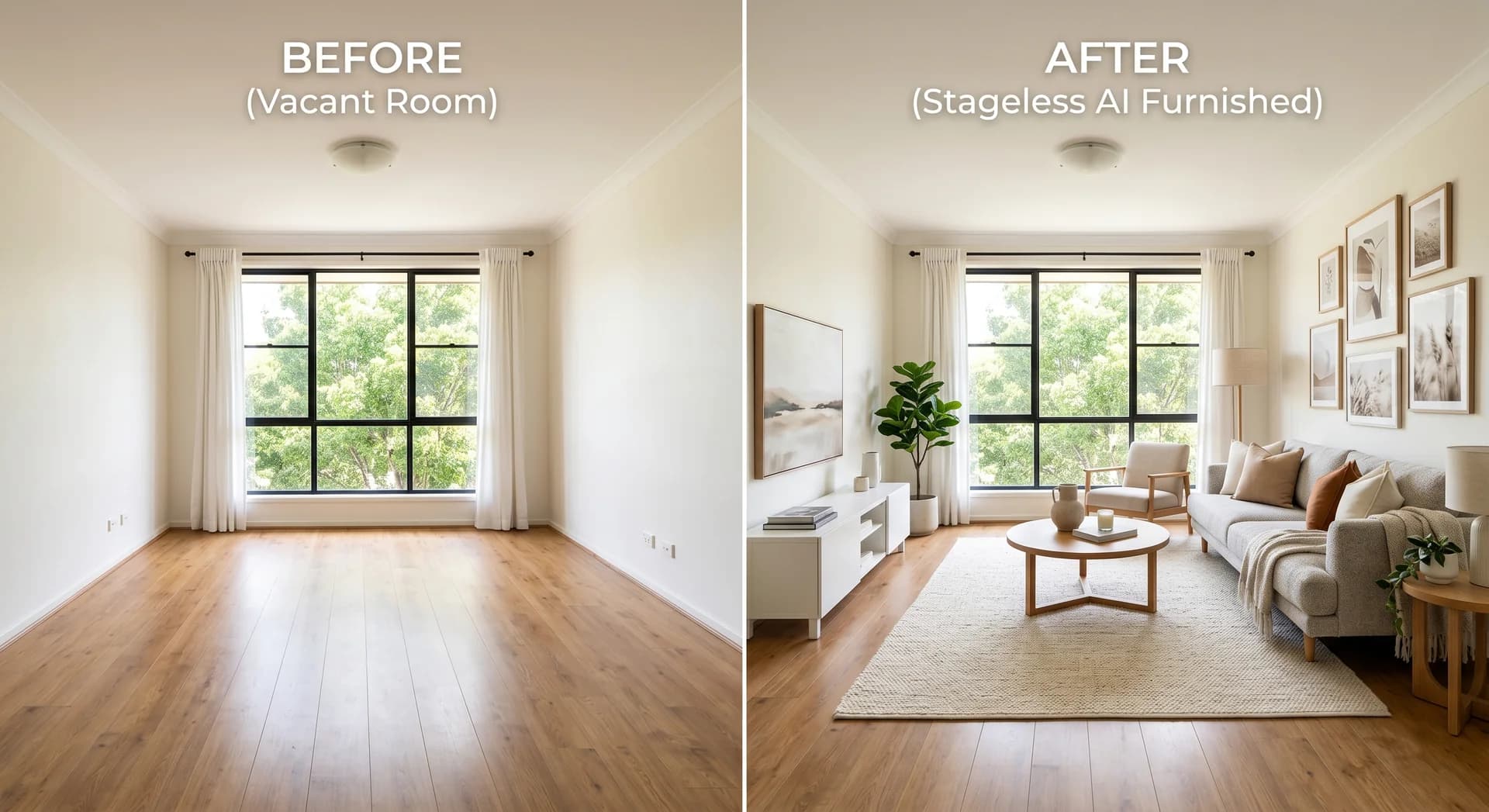
Physical staging — renting and installing furniture — costs between €2,000 and €5,000 for a typical apartment and requires days of logistics. In a slow market where cost management matters, AI virtual staging is the more practical alternative.
Tools like Stageless AI produce photorealistic 4K staged images from empty room photographs in under 30 seconds, at €0.60 per photo. A five-room property can be fully staged for under €15. The staged photographs are used in the listing; buyers are informed at viewing that the property is unfurnished. The visual effect on listing engagement is identical to physical staging.
4. Fix the one photograph that is killing your listing
Most listings have one weak photograph that suppresses the entire gallery. It is usually a dark kitchen, a badly framed bathroom, a cramped-looking bedroom, or an unflattering exterior shot taken on an overcast day.
Buyers viewing a listing gallery do not average out the quality of the photographs. They react to the weakest one. A gallery of ten excellent photographs and one poor one will underperform a gallery of ten good photographs, because the poor one creates doubt.
The fix is to identify which photograph is weakest — often identifiable from portal analytics showing which image has the highest drop-off rate — and either retake it or improve it. Stageless AI's Auto Image Enhancement tool corrects exposure, lighting, and colour balance in existing photographs without retaking them, typically in under 30 seconds per image.
5. Rewrite the listing description from scratch
Most listing descriptions fail to do the one thing they exist to do: give buyers a compelling reason to request a viewing.
The most common failure mode is burying the property's strongest selling point in the third paragraph, after a generic introduction about the neighbourhood and the building. Buyers who have already seen fifty listings this month will not read to the third paragraph. The strongest feature — a south-facing terrace, a recently renovated kitchen, a parking space in a city where parking is scarce — must appear in the first sentence.
After the lead, the description should address each key room in two to three sentences, highlighting one specific feature per room. Avoid adjectives without evidence — "stunning views" means nothing; "unobstructed views across the river from the living room and master bedroom" means something. Close with the practical information buyers need to make a decision: proximity to transport, schools, shops.
The description should be written in approximately 200 to 300 words. Longer descriptions are not read. Shorter descriptions leave buyers without the information they need.
6. Create a video walkthrough
In a slow market, buyers are more selective about which properties they visit in person. A video walkthrough reduces the barrier to engagement by giving buyers a sense of the property's flow and atmosphere before they commit to a viewing.
A basic video walkthrough does not require professional equipment. A smartphone on a gimbal stabiliser — available for under €80 — produces sufficiently smooth footage for portal use. The walkthrough should follow a natural path through the property, spending five to ten seconds in each room, with a voiceover or on-screen text highlighting key features. Total length should be between two and four minutes.
Properties with video walkthroughs receive significantly higher engagement on portals and generate more viewing requests from buyers who are genuinely interested, rather than buyers who are unsure and visit to decide. This reduces wasted viewing appointments and improves the conversion rate from viewing to offer.
7. Share the listing on the right channels
Portal listings reach buyers who are actively searching. They do not reach buyers who are passively open to the right property but not yet actively looking — a group that, in many markets, is larger than the actively searching group.
Reaching passive buyers requires a different distribution strategy. The most effective channels are the agent's personal social media accounts, particularly LinkedIn for professional audiences and Instagram for visual impact; the agency's email database of buyers who have registered interest in similar properties in the past twelve months; and direct outreach to buyer's agents who have recently completed transactions in the same area and price range.
Each of these channels requires minimal investment of money and moderate investment of time. In a slow market, the agent who generates an offer from a passive buyer — before that buyer has even started formally searching — has a significant advantage.
8. Make the viewing experience exceptional
In a slow market, buyers visit fewer properties. This means each viewing carries more weight, and the gap between a memorable viewing experience and a forgettable one translates more directly into offers.
The fundamentals are obvious but frequently overlooked: the property should be at a comfortable temperature, smell neutral, be impeccably clean, and have all lights on. Curtains and blinds should be open to maximise natural light. Fresh flowers or a bowl of fruit in the kitchen create warmth without staging furniture.
Less obviously: the agent should arrive before the buyer, open all internal doors, and have a printed single-page summary of the property's key features and nearby amenities ready to leave with the buyer. Buyers who leave a viewing with a physical reminder of the property think about it more than buyers who leave with only a memory.
The viewing should end at the property's strongest feature — whether that is a terrace with a view, a recently renovated kitchen, or a particularly well-proportioned living room — rather than at the front door.
9. Follow up systematically after every viewing
Most buyers do not make offers immediately after viewings. They reflect, compare, discuss with partners or advisors, and often visit the property a second time before committing. In a slow market, the time between first viewing and offer is typically longer than in an active market.
Systematic follow-up fills this gap. Within twenty-four hours of every viewing, the agent should send a brief message acknowledging the viewing, offering to answer any questions, and including any information the buyer requested during the visit. At seventy-two hours, if no response has been received, a second brief message is appropriate — not to apply pressure, but to offer a second viewing if the buyer is still considering the property.
Agents who follow up systematically consistently report higher conversion rates from viewing to offer than agents who wait for buyers to re-engage spontaneously. In a slow market, buyers are comparing multiple properties over a longer period. The agent who stays present — helpfully, without pressure — captures offers that would otherwise be lost to inertia.
10. Consider an open house
Open houses are underused in most European markets, where private viewings remain the norm. In a slow market, an open house serves a function that private viewings cannot: it creates visible competition.
When three or four buyers are viewing the same property simultaneously, the psychology of scarcity activates. Buyers who might otherwise take weeks to make a decision feel a degree of urgency that they do not feel in a private viewing. This does not mean an open house will always generate an offer on the day — but it consistently accelerates the decision timeline for buyers who are genuinely interested.
An effective open house requires promotion: a specific date and time in the portal listing, messages to all buyers who have enquired about the property, personal outreach to the agent's network, and if budget allows, a targeted social media promotion in the days prior.
The property should be presented at its absolute best — professionally cleaned, fully prepared as described in tactic eight — and the agent should be present throughout, engaging buyers individually and noting their reactions for follow-up.
Stage your listing photographs and sell faster with Stageless AI — 20 free credits, no credit card required. stageless.ai/en/auth/register
Written by Stageless Team
We are a team of real estate technology experts passionate about AI. Our mission is to help agents sell faster by democratizing access to high-end virtual staging tools.