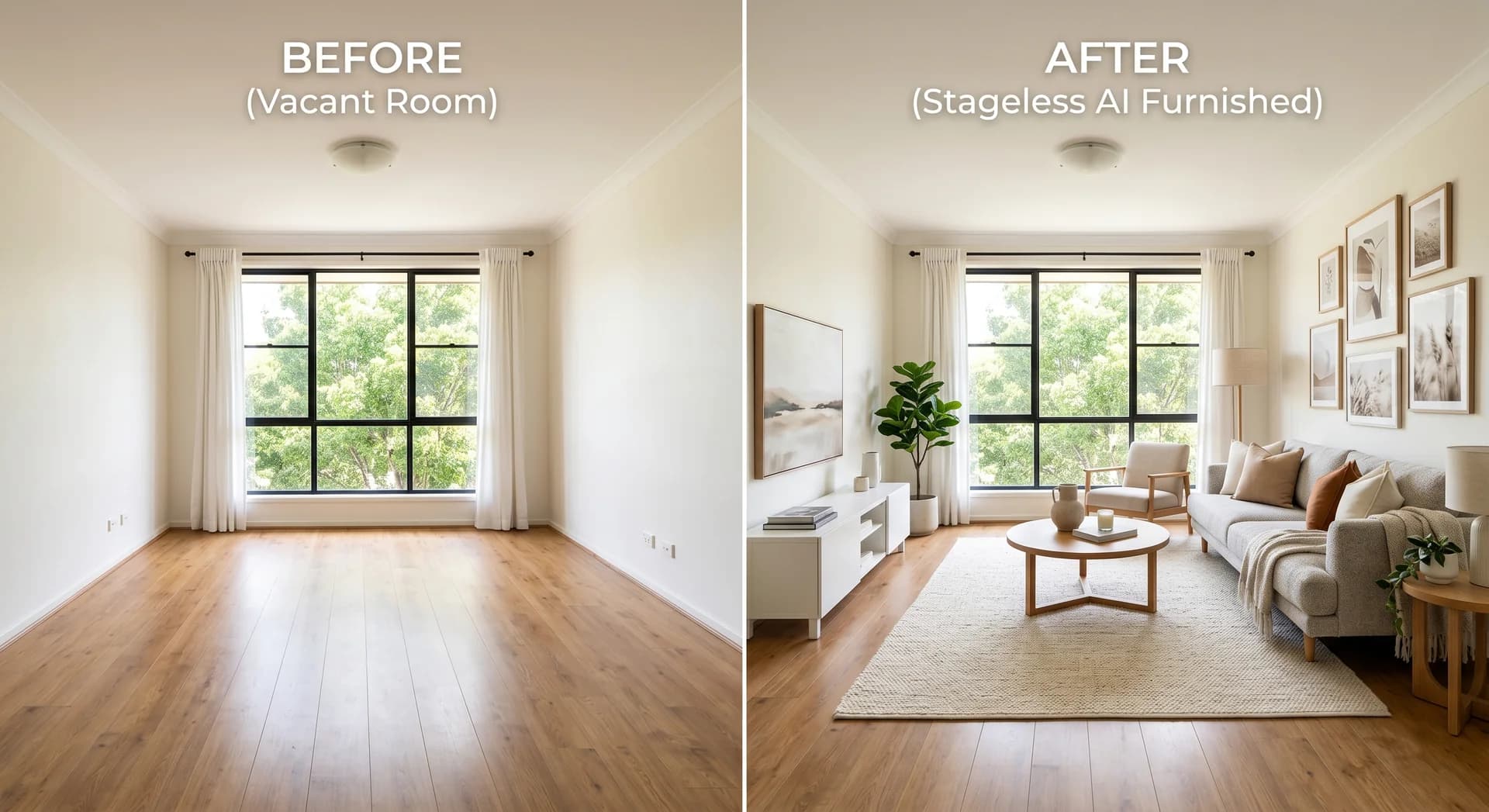
Video Tour vs. Traditional Video: Which Generates More Leads?

Stageless Team
Editor in Chief
Video has become part of modern property marketing — but not all video is equal. There is an important difference between a traditional property video filmed by a videographer and edited with music and narration, and an interactive virtual tour the buyer controls. This article compares both approaches in terms of production, cost, lead generation impact, and suitability for different property types — to help understand when each format makes more sense, and why an interactive tour like Stageless Video Tour may be more effective than traditional video for most properties an agent handles day to day. The right choice depends on the type of property, the budget available, and the stage of the buying process the prospective buyer is currently in.
What a Traditional Property Video Is
A traditional property video is a filmed production made with a video camera or drone, where a videographer walks through the property and creates an edited sequence with music, transitions, and sometimes narration or subtitles. This type of content is familiar in high-end property marketing: one- to three-minute videos presenting the property with cinematic pacing, showing the facade at dawn, interiors with careful lighting, and the garden or pool under ideal conditions. Production costs typically range from 200 to 800 euros per property, depending on complexity and location, and can rise considerably if drone footage, professional narration, or elaborate post-production is included. Production time is generally 2 to 5 business days between filming and delivery of the final video, which can complicate planning for an agent working on tight deadlines.
What an Interactive Virtual Tour Is
An interactive virtual tour is fundamentally different in nature: instead of showing buyers what the agent chose to show, at the pace the agent chose, it gives buyers control of the visit. The user navigates the property at their own pace, deciding which rooms to spend more time in, returning to spaces that interested them, and exploring details an edited video might not have shown. Stageless's Video Tour is created from regular smartphone photos — the same ones the agent already takes for the static listing — and generates an interactive MP4 file in minutes, within the platform, with no additional production cost or waiting time. This process difference — from days to minutes, from hundreds of euros to zero marginal cost — is what makes the interactive tour a fundamentally different proposition from traditional video for the daily volume of an agent's listings.
Impact on Lead Qualification
The strongest argument for the interactive tour is not cost — it is the quality of the leads it generates. A buyer who watched a traditional property video saw what the agent chose to show, at the pace the agent chose. They may have come away with a good general impression of the property, but not necessarily a realistic understanding of the space, the dimensions, or how the rooms relate to each other. A buyer who navigated an interactive tour made active decisions: they chose to enter the kitchen, return to the living room, explore the hallway. They finished with a deeper understanding of the property — and if they are still interested, their interest is more informed and more qualified. This translates into more productive in-person showings, with buyers who know what they are going to see and arrive with more specific questions.
Which Generates More Contacts: Sector Data
Available data on the impact of video in property listings points consistently in one direction: properties with video content generate more views and more contacts than properties with photos only. What is less clear is which type of video produces better results. Existing studies tend to compare video versus no video, not interactive tour versus traditional video — a data gap that makes a precise direct comparison difficult. What user behaviour data on property portals suggests is that session time — how long a user spends exploring a listing — is one of the best predictors of contact intent. An interactive tour, which invites the user to navigate actively instead of watching passively, tends to generate significantly longer session times than a 2-minute video that plays automatically. More time on the listing means greater likelihood of contact.
When Traditional Video Still Makes Sense
The interactive tour does not fully replace traditional video in every context. For high-end properties — luxury homes, properties with unique architectural features, new development projects — a well-produced cinematic video serves a different purpose: it creates an emotional narrative about the lifestyle the property represents, not just a faithful representation of the space. A drone video showing the property integrated into an exceptional landscape, or one with careful music and lighting evoking a specific feeling, is a different marketing asset from an interactive tour — less informative, more aspirational. For off-plan properties, where a project is sold before construction is complete, 3D rendered video remains the norm because there is no real property to photograph. In both cases, the interactive tour and the traditional video are complementary.
Production Cost: An Honest Comparison
The cost comparison between the two approaches is where the difference is most evident. A traditional property video for a mid-range property typically costs between 200 and 500 euros — including the videographer, editing, and delivery. For an agent who publishes 6 properties a month, that represents between 1,200 and 3,000 euros a month in video production, just to cover half the listings. Most agents do not produce traditional video for every property precisely for this reason — the marginal cost per property is too high to apply systematically. Stageless Video Tour has no additional marginal production cost — it is included in the subscription, and production time is measured in minutes, not days. This means that for the first time, an agent can have an interactive tour for every property they publish, regardless of sale value.
Integration into the Sales Channel: How to Use Each Format
The most effective way to use both formats is not to choose one over the other, but to understand at what point in the buying process each one serves best. The interactive tour works best at the top of the funnel — when the buyer is exploring options, comparing properties, deciding which ones are worth visiting. It is the ideal format to include in the portal listing, share by WhatsApp after a first contact, or publish on social media to capture new interest. Traditional video works better in the middle or bottom of the funnel — when the buyer is already seriously interested and needs an emotional argument to move forward. This distinction — interactive tour to qualify, traditional video to convert — allows both formats to be used in a complementary way without unnecessary duplication of costs. An agent who combines both formats strategically uses each tool exactly where it adds the most value, rather than applying one blanket solution to every property regardless of fit.
Impact on Sale Speed
One of the most relevant metrics in the property market is days on market — how long a property is available before it sells or rents. Video in any format tends to reduce time on market by increasing listing exposure and better qualifying the buyers who come to in-person showings. The interactive tour has a specific additional advantage: because it allows the buyer to take a full virtual visit before the in-person showing, it significantly reduces the number of showings that do not result in real interest. Every in-person showing that happens after an interactive tour is a showing from a buyer who already saw the property virtually and maintained their interest — which increases the showing-to-offer conversion rate and reduces the total number of showings needed to close the sale.
The Tour's Role in the Buyer Decision Cycle
The property buying decision process has several distinct phases: discovery, exploration, consideration, showing, and offer. Traditional video works well in the discovery phase — it catches attention, creates a positive impression, and invites further exploration. But it is in the exploration and consideration phases that the interactive tour has the advantage: while traditional video gives the buyer a curated perspective of the property, the tour returns control to explore what specifically interests them. This early qualification reduces the number of in-person showings needed to find the right buyer, which is valuable for both the agent and the owner.
Cost-Effectiveness Analysis: The Economic Argument
The economic analysis of the choice between traditional video and interactive tour depends greatly on the volume of properties the agent manages and their average sale values. For properties worth over 500,000 euros, the cost of a 300 to 600 euro professional video represents less than 0.1% of the transaction value and can be justified by the differentiation it creates. For properties between 100,000 and 300,000 euros — the bulk of the residential market in many Portuguese and European cities — that same cost represents a more significant portion of the agent's commission. In this segment, Stageless's interactive tour proposition is economically more attractive: with no marginal cost per property, it can be systematically applied to all listings without the agent having to weigh the cost each time.
What Market Data Says About Virtual Tours
Although specific data on Stageless Video Tour is still being collected — the feature is recent — broader market data on virtual tours is consistent. User behaviour studies on property portals show that listings with virtual tours generate between 40% and 80% more session time than listings with photos only, depending on the portal and market segment. The short-term rental sector, where platforms like Airbnb popularized interactive tours, shows that properties with virtual tours have noticeably higher booking rates than comparable listings without one. In the buying and selling market, the correlation is similar: properties with virtual tours tend to receive more contacts per listing view, and buyers who arrive at an in-person showing after completing a tour show greater seriousness of intent.
Which Format to Choose: A Quick Decision Guide
Given so many variables, it can help to summarise the decision into practical criteria. If the property has a sale value under 300,000 euros, is part of a portfolio with frequent listings, or the main goal is to qualify leads before the first showing, the interactive tour is usually the more efficient choice — it is included in the subscription and can be applied to every listing at no additional cost. If the property has exceptional architectural features, a high sale value, or is part of a launch campaign where the emotional narrative is central, traditional video still justifies the investment. For agents managing a high volume of properties, the most effective strategy is often hybrid: use the interactive tour as the baseline for every listing, and reserve traditional video for flagship properties that justify a dedicated production budget. This approach maximises listing coverage with interactive tours while ensuring the highest-value properties still receive the more elaborate marketing treatment they deserve. Ultimately, the question is not "which format is better", but "which format best serves this property, at this stage of the sales funnel, with this available budget".
Create your first interactive Video Tour with Stageless AI and see how it compares to traditional video in practice.
Written by Stageless Team
We are a team of real estate technology experts passionate about AI. Our mission is to help agents sell faster by democratizing access to high-end virtual staging tools.