Virtual Home Staging for Real Estate: The Complete Guide for Agents in 2026

Stageless Team
Editor in Chief
The real estate market moves trillions of dollars every year, and competition among agents has never been fiercer. With portals like Zillow, Rightmove, and Idealista attracting tens of millions of monthly searches, the battle for buyer attention begins and ends with the quality of property photos.
The problem is that the vast majority of listings still show empty rooms, poorly lit spaces, or interiors cluttered with outdated furniture. And this costs money: longer time on market, more price negotiations, and a reduced perception of value from buyers.
AI-powered virtual home staging has changed this equation. This guide explains how it works, what it costs, and why agents who have already adopted the tool are closing deals faster and with fewer discounts.
What Is Virtual Home Staging?
Home staging is the practice of visually preparing a property to make it more attractive to buyers or renters. In its traditional form, this involves hiring a company that brings physical furniture to the property — sofas, tables, artwork, rugs — and arranges the space for the photo shoot.
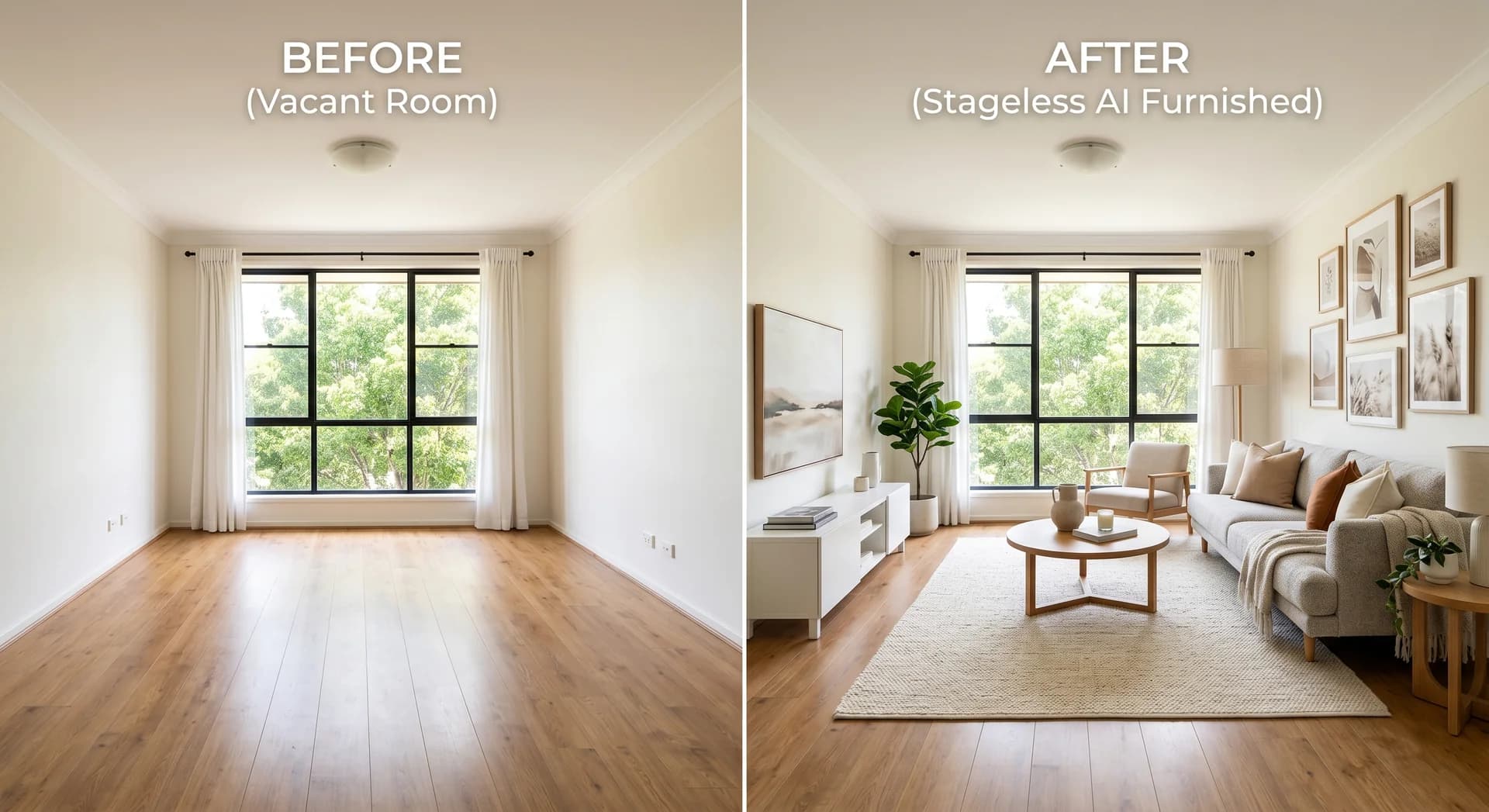
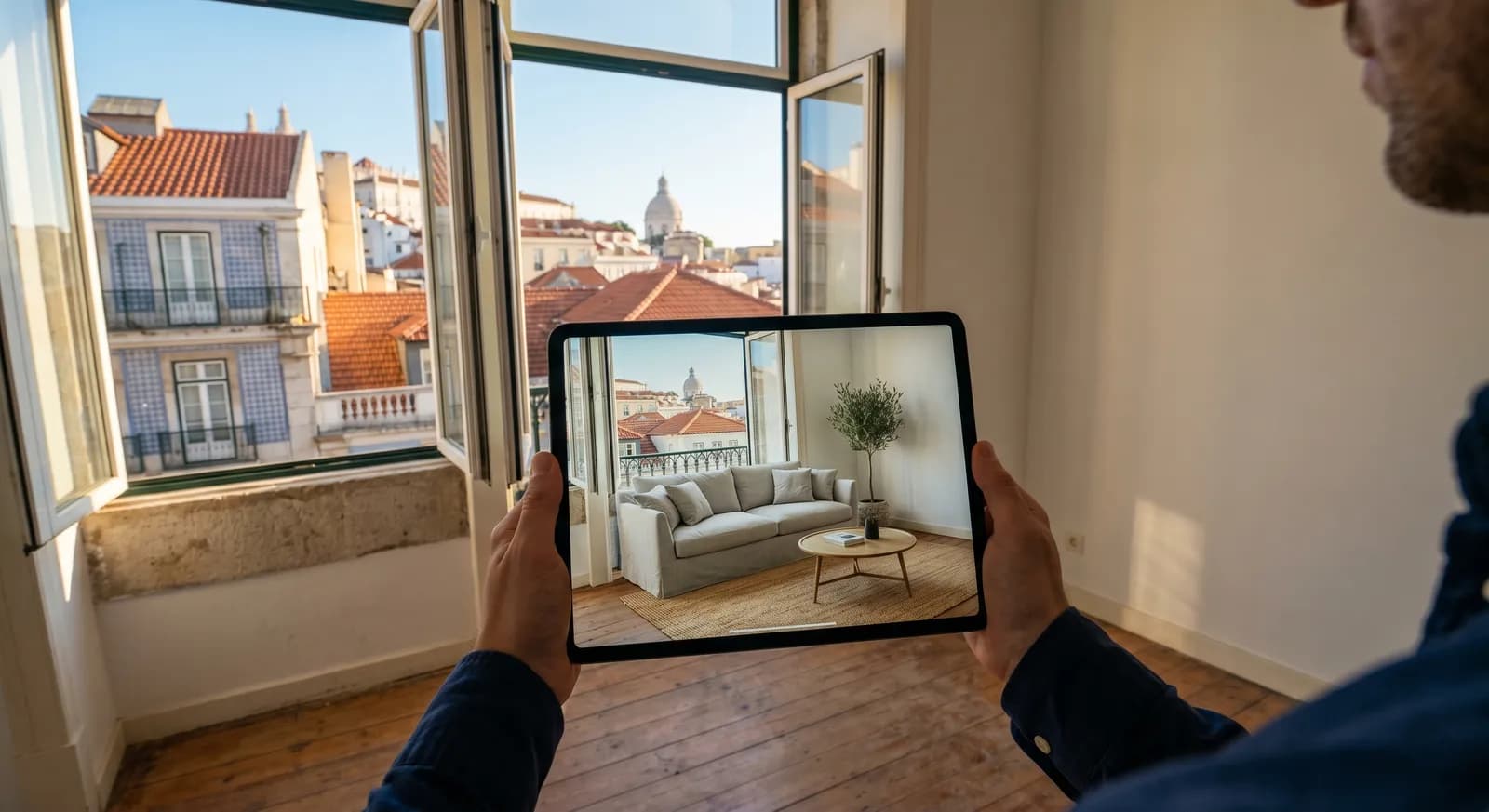
Virtual staging does the same thing, but digitally. An AI tool analyses the photograph of the empty space and inserts photorealistic furniture, décor, lighting and finishes directly into the image — without a single piece of furniture entering the property.
The result is a high-resolution photo that compellingly showcases the potential of the space, ready for publication on major real estate portals.
Why the Market Needs This Now
There are a few factors that make virtual staging particularly relevant today:
Buyers research extensively before visiting.
Real estate search behaviour studies show that most buyers browse between 5 and 15 portals before scheduling an in-person visit. The decision to schedule — or not — is made almost exclusively based on listing photos.
Most listed properties are empty or poorly presented.
This is an opportunity. The agent who presents properties with the best visual quality stands out in a feed dominated by poorly lit phone photos.
The cost of physical staging is prohibitive for most price ranges.
A physical staging company typically charges between £2,000 and £8,000 per property — a cost that only makes sense for high-end properties. For the mid-market, which accounts for the majority of sales volume, that cost makes staging impractical.
AI virtual staging starts at €0.60 per image.
For a standard apartment with five main photos, the total cost is under €3.
How AI Virtual Staging Works
The process is simple and requires no technical image editing knowledge:
1. Photograph the property.
Photograph the property as you normally would. Empty rooms work best, but quality tools can also work with lightly furnished spaces. A professional camera produces better results than a phone, but both are compatible with modern tools.
2. Upload the image.
Upload the photo to the virtual staging platform. With Stageless AI, this can be done directly from your browser or phone — no software installation required.
3. Select a style.
Choose the décor style that best suits the property profile and target buyer: contemporary, Scandinavian, Mediterranean, minimalist, and more.
4. Generate the image.
The AI analyses the room's geometry, existing lighting, and floor and wall surfaces, then inserts photorealistic furniture that integrates naturally into the scene. The process takes between 60 and 90 seconds.
5. Download and publish.
The image is delivered in 4K resolution, ready to use on real estate portals without further editing.
What's the Real Difference? Use Case Examples
Standard apartment in a residential area
A two-bedroom, 65m² apartment listed empty was generating very few enquiries. After applying virtual staging to the living room, master bedroom and kitchen, the number of interested buyers increased significantly in the first week after the photos were updated. The property sold in the second month — compared to an average of four months for similar properties in the same area without staging.
This pattern is consistent with global market data: staged properties sell, on average, 73% faster than properties presented without furniture.
Off-plan or newly delivered property
Developers who haven't yet built the property — or who are delivering bare apartments — use virtual staging to show the potential of the space in sales materials, presentations and social media. The advantage here is flexibility: it's possible to generate versions with different décor styles to target different buyer profiles.
Occupied property with old or cluttered furniture
For properties where the current owner is still in residence and the existing furniture doesn't enhance the space, the combination of AI object removal and virtual re-staging allows the property to be presented with a refreshed look without any physical intervention.
How Much Does Virtual Home Staging Cost?
Stageless AI uses a pay-as-you-go pricing model — you pay per image, with no mandatory monthly subscription.
| Plan | Price per image | Best for |
|---|---|---|
| Pay-as-you-go credits | From €0.60 | Individual agent with variable volume |
| Monthly plans | From €20/month | Agencies with regular volume |
| Volume pricing | Quote on request | Developers and large agencies |
Compared to physical staging:
| Approach | Cost per property | Turnaround |
|---|---|---|
| Physical staging | £2,000 – £8,000 | 5 to 10 business days |
| Manual staging by designer | £500 – £1,500 | 1 to 3 days |
| AI virtual staging (Stageless AI) | €3 – €15 | Under 2 minutes |
Legal Considerations: Do I Need to Disclose Virtual Staging?
Advertising standards and consumer protection regulations in most markets require that property listings do not contain false or misleading information about the characteristics of the property. This means virtual staging must be used transparently.
The recommended practice — widely adopted globally — is to include a clear note in the listing, such as:
"Images include virtual staging for illustrative purposes. Property delivered unfurnished."
What is not acceptable — and constitutes a violation — is using virtual staging to add non-existent features to the property: altering the apparent size of rooms, adding windows that don't exist, or showing a view that doesn't belong to the property.
How Agents Can Get Started
Create a free account.
Stageless AI lets you try the tool before committing — you can assess the quality of the result for yourself.
Choose two or three properties from your current portfolio.
Ideally empty properties that have been on the market longest without generating enquiries. Photograph the main spaces — living room, bedroom, kitchen — and apply the staging.
Republish the listings with the new photos.
Monitor the difference in views and enquiries over the following two weeks, comparing with the same period before the photos were updated.
Integrate into your regular workflow.
For most agents, virtual staging becomes part of the standard listing process — done on the same day as the photo shoot, before publishing the listing.
Does Virtual Staging Replace Physical Staging?
For most of the market, yes — virtual staging replaces physical staging in a cost-efficient way, especially for mid-market and upper-mid-market residential properties.
Physical staging still makes sense in specific situations: ultra-high-end properties where in-person visits are central to the purchase decision, or show apartments in large-scale developments that will receive hundreds of visits.
For all other cases — which represent the vast majority of real estate transaction volume — AI virtual staging delivers a cost-benefit ratio that physical staging simply cannot compete with.
Conclusion
AI virtual home staging has arrived in the market at a time when buyers are more digital, more demanding and quicker to dismiss listings with low-quality photos. The tool isn't a shortcut or a trick — it's the natural evolution of professional property marketing, now accessible to all agents across all price segments.
Agents who adopt virtual staging as a standard part of the listing process are, in practice, raising the visual quality of their entire portfolio — and giving buyers exactly what they need to decide to schedule a viewing.
Try it free at stageless.ai — no subscription. See the result in under 2 minutes.
Related reading: What Is AI Virtual Staging? · Affordable Virtual Staging: Stage 20 Listings Under €100 · How Virtual Staging Impacts Leads
Written by Stageless Team
We are a team of real estate technology experts passionate about AI. Our mission is to help agents sell faster by democratizing access to high-end virtual staging tools.