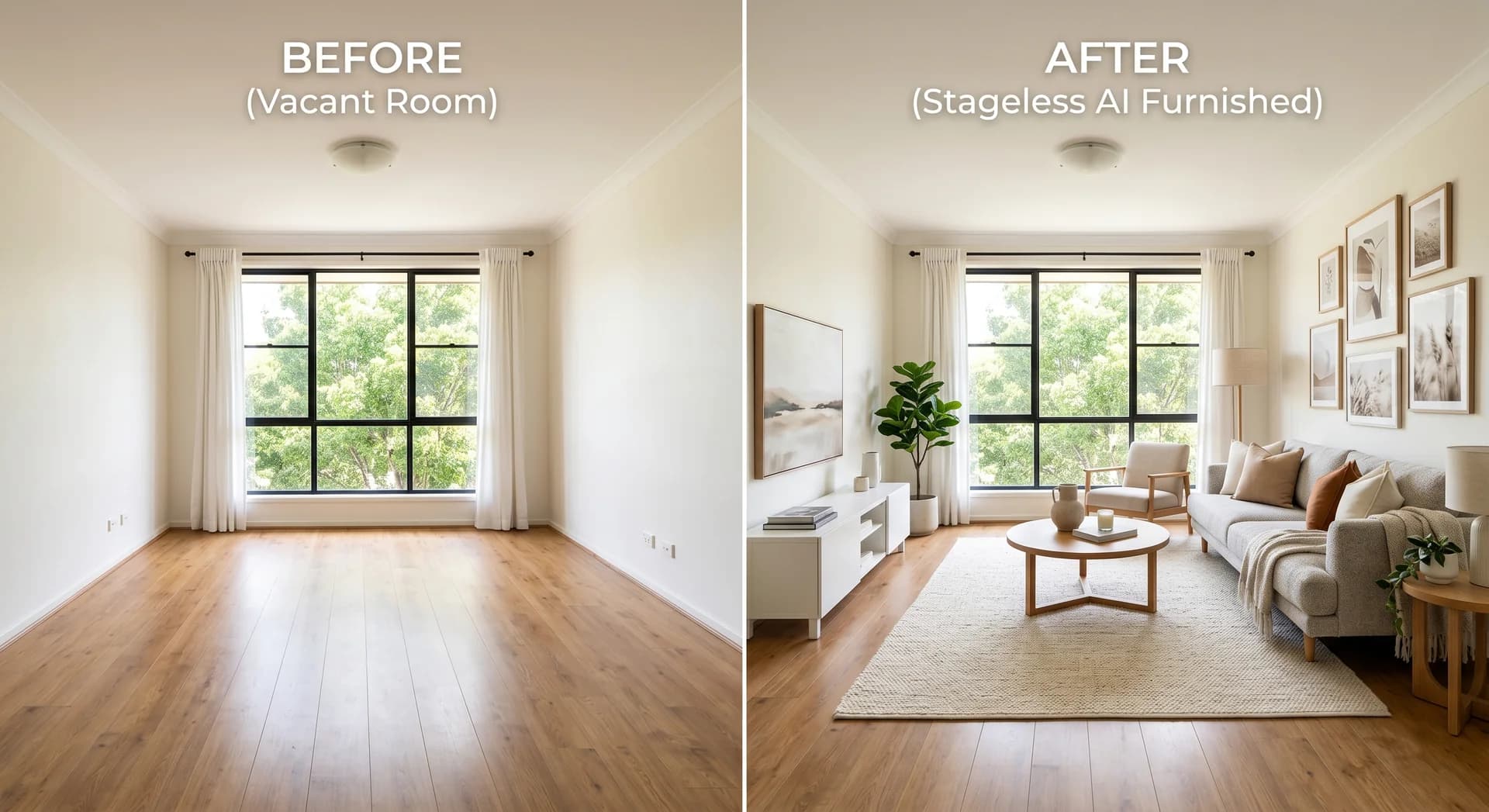
Virtual Staging Services or Doing It Yourself: How to Decide

Stageless Team
There are two ways to get furniture into a listing photo. You send the photo to a company and a person does it for you, or you use a tool and do it yourself in a couple of minutes.
The choice is usually framed as a price comparison, which is the least useful way to look at it. Price per image is the smallest number in this decision. The two that matter are how many revisions a listing actually needs and what it costs you when a property waits two days to go live.
We make a self-serve tool, so the bias is worth stating. The section on hiring a service is written to be useful whether or not you ever use ours.
What Each One Actually Is
A virtual staging service
You upload photos, describe what you want, and a human editor produces the result in 24 to 48 hours. Revisions go back through the same queue. You are buying a decision as much as an image: someone chooses the furniture, the placement and the style, and you approve or reject.
A self-serve tool
You upload the photo, pick a style, and get the result in under 30 seconds. Corrections take seconds. You are buying capacity, not a decision. The judgement stays with you, which is an advantage when you have taste and a burden when you do not.
The Numbers That Decide It
Cost per listing, not per image
A listing is not one photo. Count the photos you actually stage per property, then multiply. Twelve images at service rates is a different conversation from twelve images at tool rates, and both are different from one hero image.
Revisions
This is the number nobody publishes. Most staged photos need at least one change: the sofa is wrong, the room reads too full, the style does not match the buyer. With a service, each round is another 24 to 48 hours. With a tool, it is another thirty seconds. At one revision per listing the difference is annoying. At three, it decides the whole question.
Days on market
A property that goes live on Tuesday instead of Thursday has two more days of exposure in the portal’s freshness window. Whether that is worth anything depends on your market, and it is worth more in fast markets than slow ones. It is also the only part of this decision that touches the seller rather than your workflow.
When to Hire a Service
You list fewer than five properties a month. The turnaround costs you nothing you notice, and you avoid learning a tool for something you do fortnightly.
You do not want to make styling decisions. A good service brings judgement you would otherwise have to supply. That is worth paying for.
The room is unusual. Sloped ceilings, open-plan spaces with no clear boundaries, very small rooms, rooms with strong existing colour. Models struggle with all of these, and a human editor does not.
The listing is high value and you want one person accountable. A named contact who fixes what is wrong is worth more than a faster tool on the property that carries your quarter.
When to Do It Yourself
You list more than twenty properties a month. The turnaround becomes the bottleneck long before the price does.
You revise often. If your first version is rarely the final one, the speed of iteration matters more than anything else in this article.
You need consistency across a portfolio. Same tool, same defaults, same look across every listing you publish, without depending on which editor was on shift.
You work in a market with specific interiors. European flats, in particular, are often staged with furniture that reads as foreign. Doing it yourself lets you check every image against what a buyer in your city expects.
How to Brief a Service So the First Version Is Right
Most revision rounds are caused by the brief, not by the editor. Four things fix that.
Name the buyer, not the style. “Young couple, first purchase, city centre” tells an editor more than “modern”.
Say what the room is for. A model will guess that a small room is a bedroom. An editor who knows it is being sold as a study will furnish it as one.
Flag what must not be touched. Any defect visible in the photo stays in the photo. Say so explicitly, because it protects you as much as them.
Send the floor plan. It costs nothing and removes half the ambiguity about scale.
How to Choose a Virtual Staging Company
Five checks, in the order that exposes a weak provider fastest.
Ask to see two rooms from the same property rather than a portfolio of single images, because portfolios are curated and sets are not. Ask what the revision policy is in writing: how many rounds are included and how long each takes. Check where the editors are and what the working hours are against yours, since a twelve-hour gap adds a day to every round. Ask whether they work in your market, and look at whether the furniture in their examples looks local. Then send one paid job before you send twenty, on a property that is not urgent.
The Hybrid Most Agencies End Up With
Tool for the routine work, service for the exceptions. Twelve photos a listing through a self-serve tool, and the one difficult room or the one premium property to a human. This is what most agencies converge on after a year, and it is worth starting there rather than discovering it slowly.
The Rule That Applies Either Way
Never edit out something the buyer cannot change. Furniture, clutter, bins and cars leave with the seller. Damp, cracks and wiring do not. A service will usually refuse this request. A tool will not refuse anything, which puts the responsibility entirely on you.
In the EU, Article 50 of the AI Act has required disclosure of AI-edited listing images since August 2026. The obligation sits with you as the one publishing the listing, not with the supplier. Full detail in our virtual staging guide.
Written by Stageless Team
We are a team of real estate technology experts passionate about AI. Our mission is to help agents sell faster by democratizing access to high-end virtual staging tools.