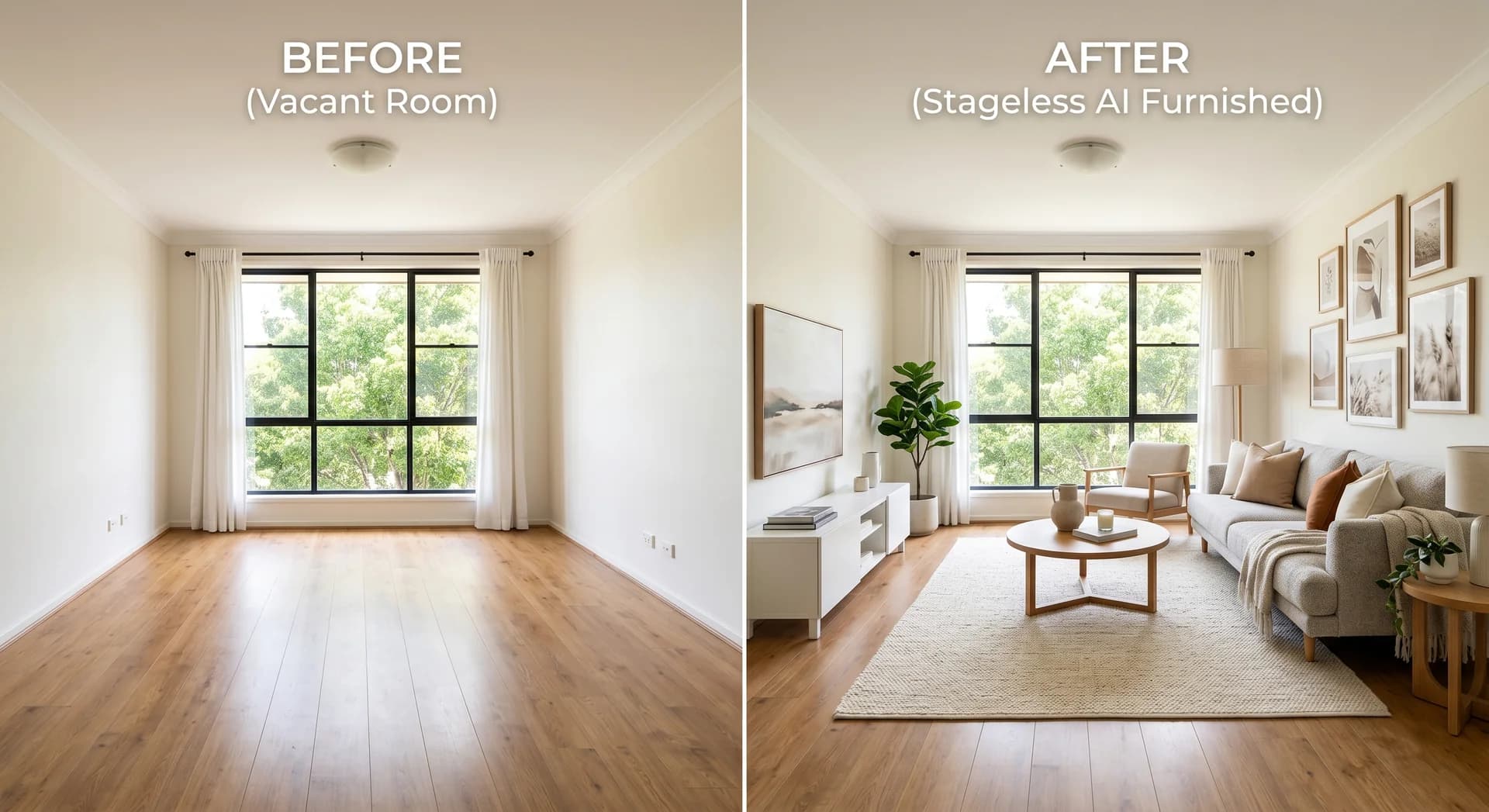
Home Staging in Portugal: What It Costs and When It Pays

Stageless Team
Editor in Chief
Ask what home staging costs in Portugal and you will get answers between 150 euros and 12,000 euros, all of them from credible sources, none of them wrong. That range is not sloppiness. It reflects a market with no standard product, where the word covers everything from a two-hour consultation to a full furniture rental for a T3.
This sets out what the published figures actually say and where each one comes from, why they diverge so widely, what the virtual alternative costs, and how to decide which of the two a specific listing justifies. It also covers what the data does not support, because the performance claims attached to this subject are almost entirely American and almost never labelled as such.
The Portuguese Market in 2026
Some context, because the decision looks different in a market moving this fast.
The INE house price index rose 17.8% year on year in the first quarter of 2026, the steepest increase in the European Union against an EU average of 5.1%, according to Eurostat. Existing dwellings rose 19.7% and new build 12.6%. At the same time 37,745 homes changed hands, 8.7% fewer than in the same quarter of 2025.
Prices up sharply, transactions down, and the older stock climbing faster than the new. Two consequences for presentation.
The first is that buyers are stretched, which makes them more critical and slower to decide. The second is that the properties reaching the market increasingly need work, which means the presentation problem is often about showing potential rather than about arranging cushions.
What Physical Home Staging Costs in Portugal
What the published figures say
Four sources, with what each covers and when it was published.
| Source | Figure | What it covers |
|---|---|---|
| Habitissimo, Nov 2024 | EUR 5,000 to 12,000 | A home staging intervention on a T3, described as an estimate |
| Maxcidadela, Aug 2025 | EUR 200 to 500 / EUR 2,000+ | Simple consultancy, versus a full project including furniture rental |
| Carolina Baracho, Feb 2024 | EUR 50 to 250 | The initial consultation only, often free or deducted from the final quote |
| ABC do Imobiliario, Jun 2023 | EUR 150 to 10,000 | The full spread of formats available, with 1 to 3% of property value as a budget ceiling |
All four are secondary sources: marketplaces, sector blogs and practitioners writing about the market rather than published price lists. None of them is a vendor tariff. Treat them as orders of magnitude, and get two local quotes before quoting a number to a seller.
Why the figures disagree so much
Because they are describing different products under one name, and that is the single most useful thing to understand about pricing here.
A consultation is a professional walking the property and telling the owner what to change. Fifty to a few hundred euros, no furniture, no execution.
A partial intervention is decluttering, depersonalising, minor repairs and repainting, executed with what is already in the property or with small purchases. Low hundreds to low thousands.
A full staging is furniture and decor rented and installed for the marketing period, then removed. This is where the figures reach five figures, because you are paying for logistics, storage and rental time rather than for taste.
So the honest answer to "what does home staging cost in Portugal" is a question: which of those three do you mean. An agent who asks that question in front of a seller looks like they know the market. One who quotes a single number does not.
The 1 to 3% benchmark
The most useful heuristic in the sources above comes from ABC do Imobiliario: 1 to 3% of the property value as a sensible budget ceiling for a staging intervention.
On a 300,000 euro apartment that is 3,000 to 9,000 euros, which lands inside the Habitissimo range for a T3 and confirms the two are describing the same thing.
It is a rule of thumb rather than a finding, and it is worth using as a ceiling rather than as a target. But it does something valuable in a conversation with an owner: it converts an abstract cost into a proportion of something they already have a number for.
What Virtual Staging Costs
The comparison is not close, and the reason is that the cost structure is different rather than smaller.
Physical staging costs money per property, because the expense is furniture, transport and time. Virtual staging costs money per image, because the expense is processing.
On Stageless AI, images start at 0.60 euros on pay-as-you-go, with monthly plans between 20 and 99 euros. Processing is under a minute per image with 4K output.
A listing needs about six staged images, the ones a buyer sees in the first row of the gallery. That is roughly 3.60 euros for the property. Thirty listings at six images each is around 108 euros, which is a full portfolio rather than one property.
Two costs that do not appear in that arithmetic and should. Your own time selecting and reviewing images, which is small but not zero. And the credits spent on outputs you discard, which is the main reason targeted editing matters: describing a change costs one operation, while regenerating the image costs another credit and produces a different arrangement that no longer matches the rest of the set.
The Comparison That Actually Matters
Most comparisons put the two side by side as if they were substitutes competing on price. They are not substitutes, and price is the least interesting difference.
Physical staging changes the property. A buyer who walks in sees the staged rooms. It works on the viewing, not just on the listing.
Virtual staging changes the listing. A buyer who walks in sees the property as it is. It works on the decision to view, not on the viewing itself.
That is the distinction that decides which one a listing needs, and it has nothing to do with the fact that one costs a hundred times more than the other.
When Physical Staging Is the Right Choice
Three situations, and they are narrower than the industry suggests.
High-value properties where the viewing is the bottleneck. If buyers are coming and not offering, the problem is at the viewing, and no image work reaches it. This is where five figures can be justified against a commission on a large sale.
Properties where the space is genuinely hard to read in person. Unusual layouts, very large rooms, spaces where a buyer standing in the middle cannot tell what the room is for. Furniture answers that question physically in a way a photograph cannot.
Show units in a development, where one staged apartment serves as the reference for forty identical ones. The cost is amortised across the whole project, which changes the arithmetic completely.
When Virtual Staging Is the Right Choice
Empty properties, which is the clearest case. An empty room gives a buyer no sense of scale and no reason to stop scrolling, and the fix is needed in the gallery rather than in the property.
Occupied properties with dated or heavy furniture. Declutter the photograph first, then stage the cleared room. Physically emptying an occupied property is not usually available to you.
Properties needing work, where the point is showing potential rather than arranging what is there. Renovation of floor coverings and wall finishes does something furniture cannot.
Any listing where the budget will not stretch to four figures, which is most of them. This is the actual reason virtual staging became standard: not that it is better, but that it made presentation available on properties where physical staging was never going to happen.
Portfolio work. Thirty listings is 108 euros virtually and an impossible number physically.
When Neither Is the Answer
Worth saying, because we sell one of the two.
If the asking price is above the market, presentation does not fix it. A well-photographed overpriced property is an overpriced property that photographs well.
If the location is the objection, nothing in the gallery addresses it.
If the listing is generating impressions and no clicks, look at the first gallery image before you look at staging. On most portals that image is the exterior, and a grey facade shot on an overcast morning with a car in the driveway loses the buyer before any interior is seen.
If it is generating clicks and no viewings, then presentation is a reasonable hypothesis and this is where staging earns its place.
Disclosure in Portugal
Article 50 of the EU AI Act has applied since 2 August 2026 and applies in Portugal as in every member state. If you publish a virtually staged photograph, you are the deployer of an AI system and the disclosure duty is yours.
Portugal has no rule specific to AI in property advertising. What applies is Article 50 plus the general regime on misleading advertising and unfair commercial practices. In Spain the Direccion General de Consumo confirmed there is no sector-specific prohibition while describing AI retouching in property advertising as unfair competition. The absence of a dedicated rule is not the absence of exposure.
In practice: a visible label on the image, a line in the description stating that images include virtual staging and that the property is delivered unfurnished, the originals available on request, and an internal record of what was edited.
Idealista has built this into its product. From its help centre, updated 27 July 2026, you can flag AI-generated or AI-modified photos from your private area, and flagged photos carry a visible label on the image. Idealista also detects AI content automatically using C2PA content credentials and its own detection model, and applies the label itself when
The practical advice that follows: flag your own photos rather than waiting to be detected. A label you applied reads as good faith. A label applied by a detection model reads as something else.
What the Studies Actually Say
Articles on this subject routinely quote figures on how much faster staged properties sell and how much more they achieve. Those figures come almost entirely from two American sources, the National Association of Realtors and the Real Estate Staging Association, and the most-quoted claims do not come with published sampling methodology. The widely circulated comparison of 23 days against 143 days originates with the Real Estate Staging Association, in the United States.
No European study with a published sample exists on the effect of virtual staging on time to sell or on final price in Portugal or Spain. Associations in both markets cite the same American material.
There is also a claim circulating in Portuguese sector content that neutral repainting can add up to 3% to a property value. We could not source it and are not repeating it.
The mechanism is plausible. A buyer who can read a room is more likely to view it, and a buyer who views is more likely to offer. The percentages are not verified for this market, and an agent who quotes them to a seller is exposed if the seller later checks.
Getting Started
The useful first test is not a comparison, it is a single listing.
Take the property in your portfolio with the most impressions and the fewest clicks. Stage its first three gallery images. Leave everything else identical, including the price and the description. Then look at whether the clicks move over four weeks.
That tells you more about whether presentation is your bottleneck than any cost table can, and it costs under two euros.
Stageless AI runs in a browser, from 0.60 euros per image, with three free credits on signup and no credit card required. Try it free at stageless.ai.
Written by Stageless Team
We are a team of real estate technology experts passionate about AI. Our mission is to help agents sell faster by democratizing access to high-end virtual staging tools.