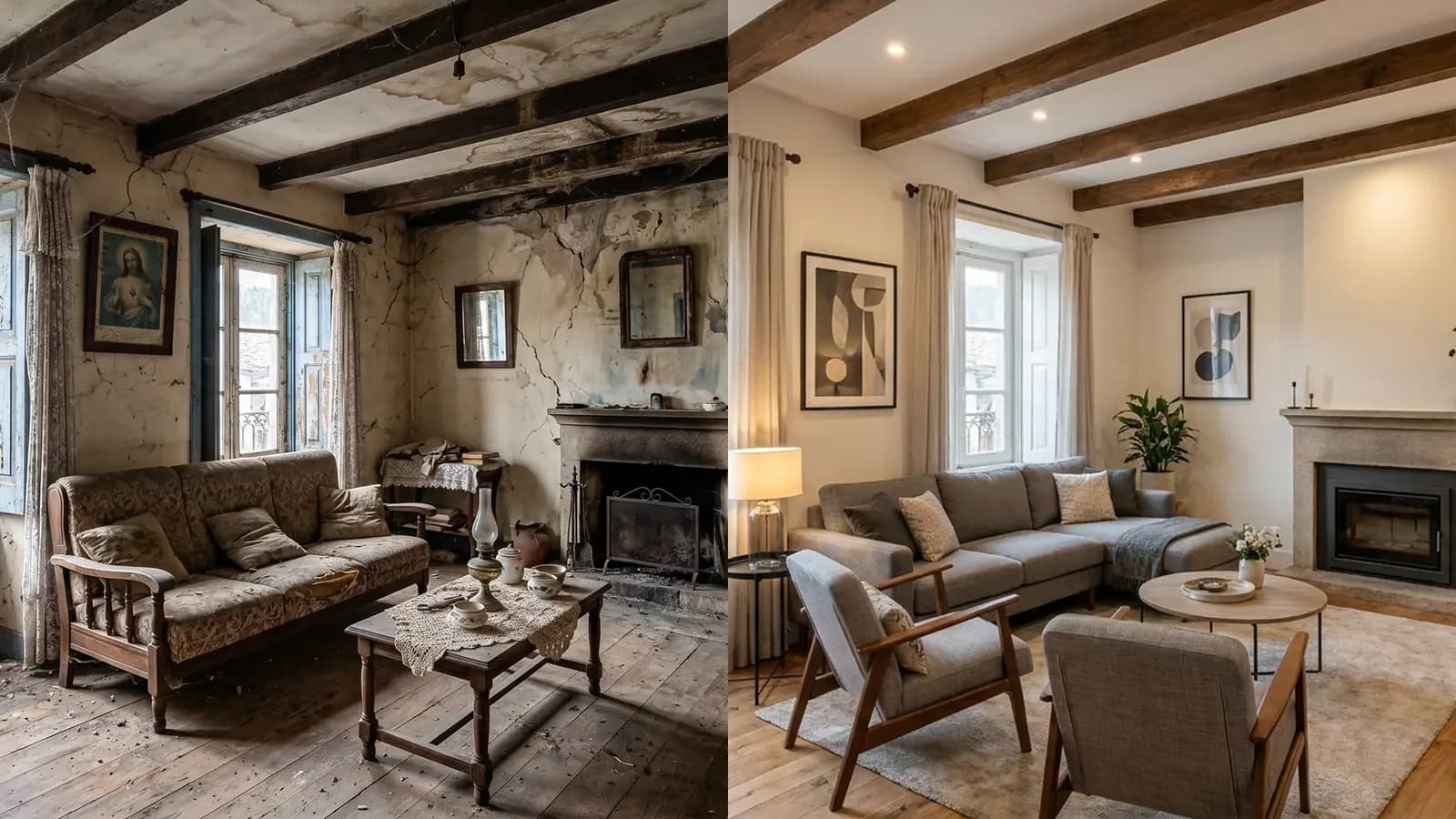
Virtual Staging Companies Compared (2026): Prices, Turnaround and Who Each One Suits

Stageless Team
Virtual staging companies fall into two camps. Studios use human editors who furnish each photo by hand and deliver in a day or two. AI platforms furnish a photo in seconds and charge from well under a dollar or a euro per image. A few companies sell both. The price gap between them is large: from about $0.24 to $34 per photo among the nine providers in this guide.
We checked each company's own pricing page in October 2026. For every one you get the type of service, the price, the turnaround, the revision policy, what it does well, where it falls short and who it suits. We make one of the tools, Stageless AI, so read with that in mind. It is one option here, not the answer to every row. If you only want software, our ranking of the best AI virtual staging tools compares the options.
Virtual Staging Companies at a Glance
| Company | Type | Price (as listed) | Turnaround | Revisions | Best for |
|---|---|---|---|---|---|
| BoxBrownie | Human studio | US$30 per image | Under 48 hours | Free changes within 2 months | Agents who want a finished job with no editing |
| Styldod | Human studio | $23 per image, $16 from 8 images | 24 to 48 hours, rush options | Unlimited free | Full listings ordered in one batch |
| PadStyler | Hybrid | AI from $0.65 per photo, bespoke $23 to $34 | AI in seconds, bespoke under 24 hours | Unlimited on bespoke | Agents who want both options from one supplier |
| Virtual Staging AI | AI platform | $16 to $79 per month (6 to 150 photos) | About 10 to 15 seconds | Unlimited regenerations | US agents with steady monthly volume |
| REimagineHome | AI platform | $14 to $99 per month range | 2 to 5 minutes per batch | 1 credit per generation | Staging with real, buyable products |
| Collov AI | AI platform | $19 to $127 per month (60 to 526 credits) | Under 15 seconds | Not stated | High volume at a low cost per photo |
| Pedra | AI platform | €29 per month (100 credits) | Seconds per photo | Credit refund on poor results | Agents who want staging, video, tours and plans in one tool |
| Apply Design | AI with DIY editor | $7 to $15 per 2D image (coins) | 15 minutes (auto) | Unlimited DIY | Agents who want control over each piece of furniture |
| Stageless AI | AI platform | €0.60 per photo, plans from €10.99 per month | Under 30 seconds | A new version costs one credit | European agents with many listings and variable volume |
All prices are taken from each provider's own website, checked in October 2026. US providers price in dollars. We have not converted them, because exchange rates move and your card provider will add its own margin.
Studio, AI or Hybrid: What You Are Buying
The word "company" hides three very different products.
A human studio is a service. You upload photos, write a short brief and wait. An editor picks furniture from a 3D library, places it and corrects shadows. You get a finished image and can ask for changes. You pay per photo, usually between $16 and $34. Our guide to virtual staging services explains how to order from a studio and write the brief.
An AI platform is software. You upload a photo, pick a room type and a style, then get a result in seconds. If you do not like it, you generate again. You pay through a monthly plan or credits, which brings the cost per photo down to cents or a few dollars.
A hybrid company offers both under one account. You use AI for most rooms and send the difficult ones, such as an odd-shaped attic, to a human editor.
The right choice depends less on quality claims than on how many photos you stage each month and how much time you have to check results.
The Virtual Staging Companies, One by One
BoxBrownie
BoxBrownie is a photo editing studio. Its virtual staging page states that "professional editors" measure the room digitally and place furniture by hand. The price is US$30 per image, pay as you go, with no subscription. Delivery is under 48 hours. Changes are free if you ask within two months of the original order.
Strengths: a finished, human-checked image with no software to learn. Item removal starts at US$10 per image and 360° staging costs US$60. Limits: at US$30 per photo, a full listing quickly costs hundreds. You also wait up to two days for each round.
Best for: agents who stage a few premium listings a year and prefer to delegate the whole job.
Styldod
Styldod is a studio service. Its virtual staging page lists $23 per image for orders under eight photos and $16 per image from eight photos. Standard delivery is 24 to 48 hours. Delivery within 24 hours costs $6 more per image, within 12 hours $12 more. Revisions are unlimited and free.
Strengths: the bulk price rewards ordering a whole listing at once. Rush delivery is clearly priced. Limits: the page does not say explicitly whether the work is done by people or software. Rush fees add up fast on a large listing. Styldod, Inc. also publishes REimagineHome, its AI product (see below).
Best for: agents who shoot a full property and want every room delivered together, finished by a studio.
PadStyler
PadStyler sells two products. AI virtual staging is a subscription billed yearly: $16 a month for 6 photos, $19 for 20 photos and $39 for 60 photos, which is $0.65 per photo on the largest public plan. Bespoke virtual staging is done per order: $34 for one photo, $31 from two, $27 from five and $23 from eight. Bespoke delivery is under 24 hours, with unlimited revisions and a money-back guarantee.
Strengths: one supplier for quick AI rooms and hand-finished hero images. A price-match promise on bespoke work. Limits: AI photos do not roll over, so unused credits are lost at the end of the month. The AI plan prices and photo counts are identical to those of Virtual Staging AI.
Best for: agents who want AI for everyday listings and a studio option for the cover photo.
Virtual Staging AI
Virtual Staging AI is an AI platform that says it was developed at the Harvard Innovation Lab. Its prices page lists four plans: 6 photos for $16 a month, 20 for $19, 60 for $39 and 150 for $79. That gives $2.67 down to $0.53 per photo. The page advertises up to 50% off for yearly billing but does not show each monthly rate clearly. Results take about 10 to 15 seconds. Regenerations are unlimited. The homepage lists more than 50 design styles and furniture removal.
Strengths: unlimited regenerations remove the fear of paying for a bad result. You can test an image for free with no sign-up. Limits: the largest public plan stops at 150 photos a month. The site does not state an output resolution.
Best for: agents in North America or elsewhere with steady monthly volume who want a simple subscription.
REimagineHome
REimagineHome is an AI platform from Styldod, Inc. Plans are named by monthly credits: Essential (30), Pro (200), Advanced (400) and Agency (900). The pricing page does not show a price per plan. Its title gives a range of $14 to $99 a month. One generation costs one credit. Adding real products costs two. New users get five free designs. The batch workflow takes up to 50 photos at once, with a turnaround of 2 to 5 minutes.
Strengths: furniture comes from real retailers, so a buyer can see pieces that exist. Batch upload sorts photos by room. Limits: the pricing page does not show the price of each plan. High-resolution exports are not included in Essential. REimagineHome also earns a commission when users buy the products shown. If you are weighing it against others, read our guide to REimagineHome alternatives.
Best for: agents and developers who want staged rooms tied to products a buyer can actually order.
Collov AI
Collov AI is an AI platform. Its pricing page lists Standard at $19 a month for 60 photo credits, Advanced at $49 for 150, Premium at $79 for 263 and Enterprise at $127 for 526. That works out at roughly $0.24 to $0.33 per photo. Its homepage promises results in under 15 seconds and multi-angle staging, so the same furniture appears across several photos of one room. Premium and Enterprise add human-assisted multi-angle staging at 20 credits per image.
Strengths: one of the lowest costs per photo in this list. Consistent furniture across angles. Limits: four headline styles on the homepage. No turnaround stated for the human-assisted option.
Best for: high-volume users who need many rooms staged at the lowest unit price.
Pedra
Pedra is an AI platform run by Pedra Software SL, a Spanish company, with prices in euros. The Pro plan costs €29 a month for 100 credits, or €239 a year for 1,200 credits. Staging costs one credit per image. Extra packs start at 200 credits for €52. Both plans include unlimited property videos, 360° tours, 2D floor plans and an API. The free trial gives 7 credits, one video and one tour.
Strengths: the broadest feature set here, with staging, video, tours and floor plans in one subscription. It refunds credits for results you are not happy with. Limits: the site does not state an output resolution. The mobile app is listed with the annual plan. We have a separate page on Pedra alternatives.
Best for: agents who want one tool for photos, video and floor plans and will use most of it every month.
Apply Design
Apply Design sells "Apply Coins". One coin costs $10 up to 9 coins, $8 from 10 and $7 from 20. Auto staging uses 1.5 coins per 2D image, with a 15-minute turnaround and on-the-spot revisions. DIY staging uses 1 coin per 2D image and gives you a drag-and-drop editor with unlimited revisions. The first image is free.
Strengths: the DIY editor lets you move, swap and resize every piece. Useful when a seller is picky about the layout. Limits: at $7 to $15 per image it costs more than most AI platforms. DIY takes your own time.
Best for: agents and photographers who want precise control and accept paying more per photo for it.
Stageless AI
Stageless AI is our product, developed by the AI Lab of Caixa Mágica Software in Lisbon. It charges €0.60 per photo. Plans have no commitment: Base at €10.99 a month for 20 credits and one AI video tour, and Pro at €44.99 a month for 100 credits and three video tours. Each image is processed in under 30 seconds and exported in 4K. The site claims "100% preservation of original structure, depth and perspective". Paid plans include object removal, decluttering, virtual renovation and space redesign. Styles include Nordic, Modern, Industrial, Minimalist, Japandi and two luxury looks.
Strengths: low cost per photo with no monthly lock-in. 4K output. AI video tours from the same photos, included in the plan. Limits: no human editor for difficult rooms. No native app, although the web platform works from a phone browser. No team accounts or API. The free trial adds a watermark and is for personal use only. A new version of a room costs one more credit. Our comparison of Stageless AI vs competitors goes into more detail.
Best for: European agents and photographers with 10 to 30 listings a month whose volume changes from month to month.
What a Listing Costs With Each Company
Prices per photo only matter when you multiply them. Below are two scenarios. The first is one listing with 10 staged photos. The second is 20 listings a month at 10 photos each, so 200 photos.
| Company | One listing, 10 photos | 20 listings a month, 200 photos |
|---|---|---|
| BoxBrownie | US$300 | US$6,000 |
| Styldod | $160 (bulk rate) | $3,200 |
| PadStyler bespoke | $230 (8+ rate) | $4,600 |
| PadStyler AI / Virtual Staging AI | $19 (20-photo plan) | Above the largest public plan (150 photos for $79) |
| REimagineHome | Within the $14 to $99 range | Within the $14 to $99 range |
| Collov AI | $19 (60-credit plan) | $79 (263-credit plan) |
| Pedra | €29 (100-credit plan) | €81 (plan plus 200-credit pack) |
| Apply Design auto | $120 (15 coins at $8) | $2,100 (300 coins at $7) |
| Apply Design DIY | $80 (10 coins at $8) | $1,400 (200 coins at $7) |
| Stageless AI | €6 at €0.60 per photo, or the €10.99 Base plan | €120 at €0.60 per photo |
These figures assume one result per photo is good enough. With studios, extra rounds are free. With most AI platforms, each new attempt uses another credit, unless the platform offers unlimited regenerations or refunds. Budget 10 to 20% extra credits for AI if you are picky.
The pattern is clear. For one premium listing a year, a studio's cost is easy to absorb. For 20 listings a month, the difference between US$6,000 and less than €150 decides whether staging becomes a standard part of every listing or stays an occasional extra. Our full breakdown of virtual staging cost covers physical staging too.
How to Choose a Virtual Staging Company
Use this checklist when you compare providers. It works for studios and AI platforms alike.
- Price per listing, not per photo. Multiply by the photos you really stage per property and by your monthly listings. Check what happens to unused credits.
- Revisions. Ask how many rounds are free, how long you have to ask and whether each AI regeneration costs a credit.
- Turnaround. Two days is fine for a premium listing prepared in advance. It is too slow when the seller signs on Monday and wants the listing live on Tuesday.
- Structure preservation. Windows, doors, radiators, floors and ceiling height must stay where they are. Test with a room that has an awkward feature, such as a sloped ceiling or a radiator under a window.
- Resolution. Ask for the export size. Many sites do not state it. Portals compress images, so start large.
- European interiors. Test with a typical property from your market: a narrow Lisbon flat, a Madrid piso with a long hallway, a Berlin Altbau with high ceilings. Check that furniture is in scale.
- Data location and GDPR. Property photos can show family pictures, documents or faces. Ask where photos are processed and stored, how long they are kept and whether they are used to train models.
- Labelling for the EU AI Act. Check whether the tool helps you mark images as virtually staged. You will need to label them in the listing anyway.
Test Before You Commit: A 30-Minute Trial
Most companies offer a free image or trial credits. Use them on the same photos so the comparison is fair.
- Pick three photos: an easy living room, a small bedroom and one awkward room, such as a kitchen with open shelving or an attic.
- Run the same three through two or three providers. Use the same style each time, for example Modern or Scandinavian.
- Open each result at full size. Check the floor line under the sofa, shadows near windows and whether door frames stayed straight.
- Time the process from upload to download. Include the minutes you spent choosing options and fixing errors.
- Count what the trial cost in credits, including any second attempts.
- Show the results to a colleague without saying which tool made which. Pick the one that looks most like a real, furnished home.
Thirty minutes spent this way is worth more than any review, including this one.
Which Company Suits Which Agent
Independent agent with 10 to 30 listings a month
An AI platform with flexible plans. Volume changes, so avoid long commitments. Stageless AI, Collov AI or Virtual Staging AI fit this profile. Compare the monthly bill against your real listing count for the last three months.
Agent with a few premium listings a year
A studio. BoxBrownie or Styldod deliver a finished job with free changes. The cost per listing is high, but the number of listings is low.
Real estate photographer
A hybrid or a DIY tool. PadStyler lets you offer AI staging as a cheap add-on and bespoke staging as a premium. Apply Design's DIY editor gives you control when a client wants a specific layout.
Developer with show flats and finished units
A mix. Renders sell the project before it exists. Once units are finished, an AI platform stages the real photos at a fraction of a studio's price. Consistency across units matters, so test multi-angle staging.
Agent who also needs video and floor plans
Look at the full bundle. Pedra includes videos, tours and plans in one plan. Stageless AI includes one or three AI video tours a month built from the staged photos.
Red Flags When Choosing a Virtual Staging Company
- No public price. If you must book a call to learn the cost per photo, expect a sales process and a quote that changes with volume.
- Prices that do not match across the site. Check the pricing page, not the meta description or an advert.
- Altered architecture. If a test image moves a window, removes a radiator or widens a room, do not use that tool for listings.
- Credits that expire quickly. A cheap plan is not cheap if half the credits disappear at the end of each month.
- No answer on data. A provider that cannot say where your photos are stored is a risk for an EU agency.
- Images with no way to label them. You will need to mark staged images. A provider that discourages it is giving you a liability.
- Furniture that is out of scale. A king-size bed in a 9 m² room misleads buyers and leads to disappointing viewings.
Labelling Staged Photos Under the EU AI Act
Article 50 of the EU AI Act requires deployers of AI systems that generate or manipulate image content constituting a deepfake to disclose that the content is artificially generated or manipulated. A virtually staged room shows furniture that is not there. Treat it as content you must disclose.
In practice, mark each staged image clearly, for example "virtually staged". Publish the original photo alongside. This applies whichever company you choose, studio or AI. A human-made edit is not exempt from honest advertising rules either.
Sources
- BoxBrownie, pricing (checked October 2026)
- BoxBrownie, virtual staging (checked October 2026)
- Styldod, virtual staging (checked October 2026)
- PadStyler, pricing (checked October 2026)
- Virtual Staging AI, prices (checked October 2026)
- Virtual Staging AI, homepage (checked October 2026)
- REimagineHome, pricing (checked October 2026)
- REimagineHome, homepage (checked October 2026)
- Collov AI, pricing (checked October 2026)
- Collov AI, homepage (checked October 2026)
- Pedra, pricing (checked October 2026)
- Pedra, homepage (checked October 2026)
- Apply Design, pricing (checked October 2026)
- European Commission AI Act Service Desk, Article 50
Written by Stageless Team
We are a team of real estate technology experts passionate about AI. Our mission is to help agents sell faster by democratizing access to high-end virtual staging tools.