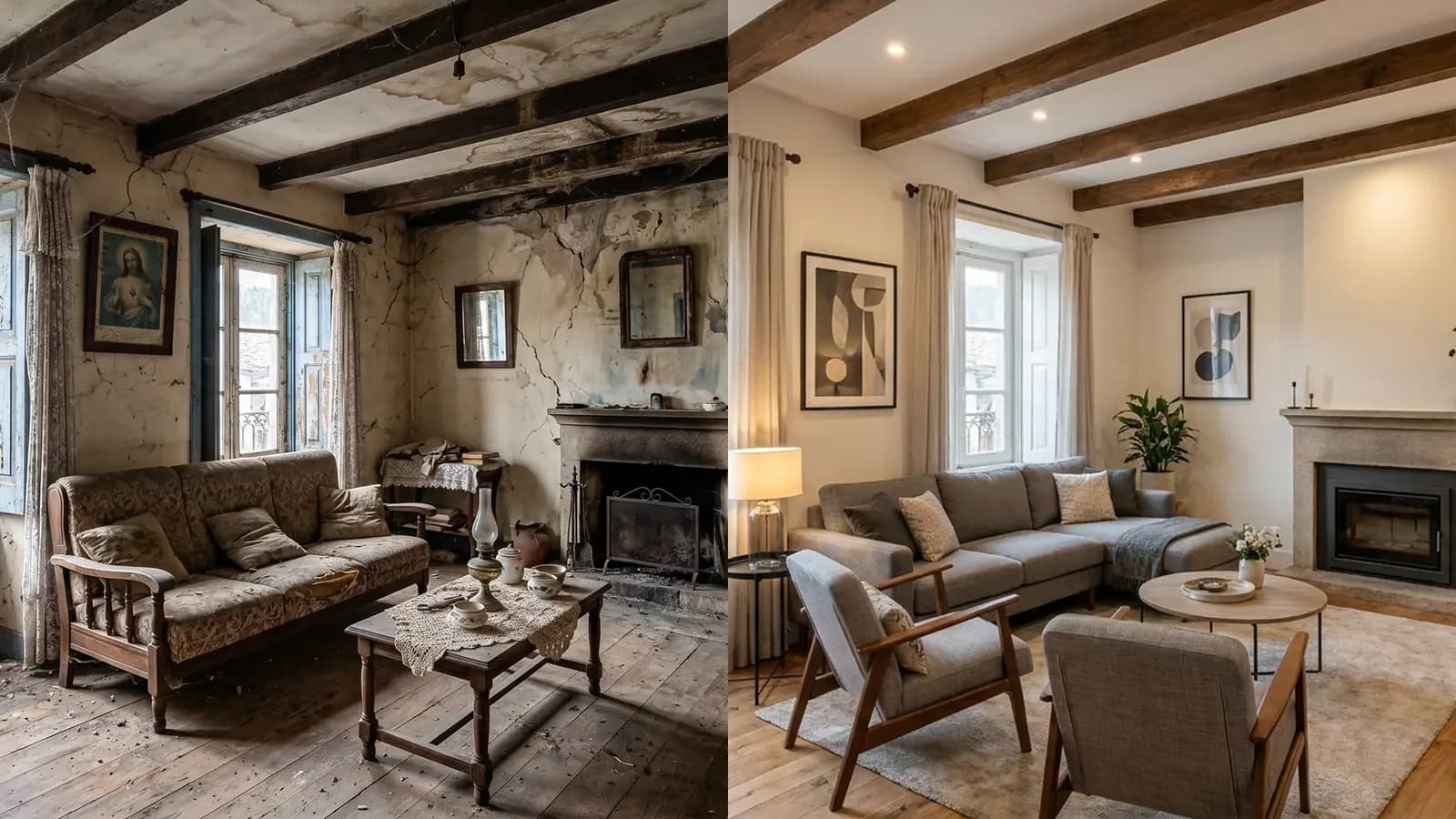
Virtual Staging Services: Studio vs AI, Prices, Turnaround and How to Order

Stageless Team
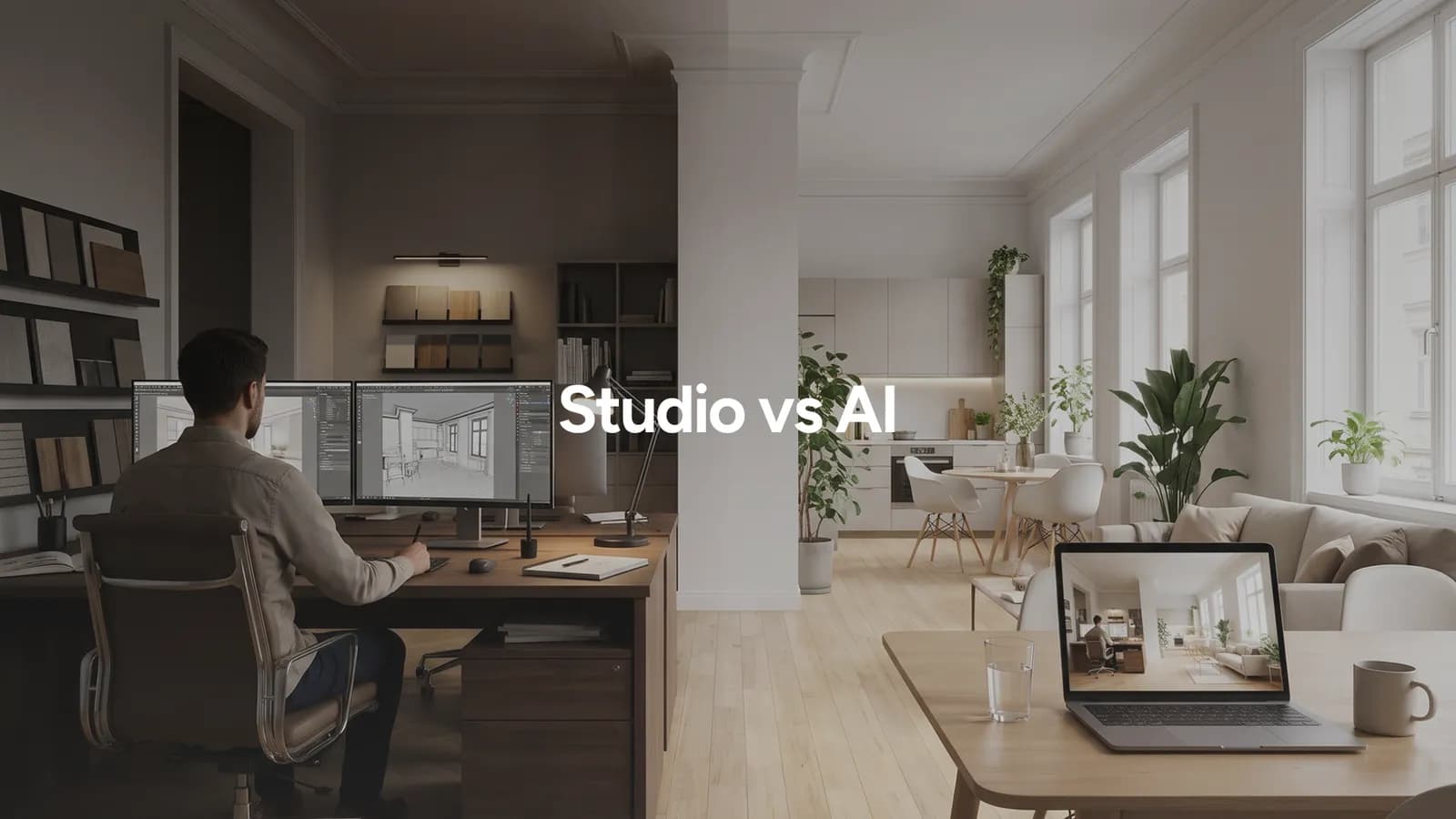
Virtual staging services furnish photos of empty or dated rooms so a listing looks lived in. You can buy them in three ways: from a studio where a designer does the work, from an AI platform where you do it yourself in seconds, or from a hybrid that mixes both. Prices run from under €1 to more than €100 per photo. Turnaround runs from seconds to five working days.
Not sure yet whether to outsource at all? Start with Virtual Staging Services or Doing It Yourself: How to Decide.
This guide is about buying the service well. It covers what you get, what it costs, what is extra, how to brief the job and how to check what comes back. We make a dedicated tool, Stageless AI, so read with that in mind. If you want a ranking of named providers, see our guide to virtual staging companies. Our overview of digital staging compared with 3D rendering helps if the method is still open.
What a Virtual Staging Service Delivers
At the simplest level, you send photos and receive the same photos with furniture, rugs, lighting and décor added. The room itself should not change. Walls, windows, doors, floors and ceiling height stay where they are.
A complete order usually includes:
- One staged image per photo you send, in the style you chose.
- The resolution you need for portals and print. Ask for it in writing.
- A set number of revisions or a price per new version.
- A delivery deadline, counted in hours, working days or seconds.
- The right to use the images in your listing and marketing.
Many services also sell related edits on the same order: removing existing furniture, virtual renovation of floors and walls, day-to-dusk conversions and floor plans. These are often where the final bill grows, so we cover them separately below.
The Three Virtual Staging Service Models
Done-for-you studio
You upload photos, fill in an order form and a designer stages each room by hand with 3D furniture models. You wait for the files, then ask for changes if needed. BoxBrownie, one of the best-known studios, charges US$30 per image with delivery in under 48 hours and unlimited changes requested within two months of the original job (checked October 2026). In Germany, the studio Maverick Frame quotes about €20 to €80 per image, with two to five working days per property including one correction round (updated July 2026).
Studios suit agents who want to hand the job off completely. You pay for a person's time, so you also wait for it.
AI self-service platform
You upload a photo, pick a room type and a style, then generate the result yourself. Nobody else touches the image. Virtual Staging AI lists plans from $16 a month for 6 photos to $79 a month for 150 photos, with results in about 10 to 15 seconds (checked October 2026). Stageless AI charges €0.60 per photo and returns each image in under 30 seconds, in 4K. A different version costs one more credit. There is no revision round to wait for.
Self-service suits agents with many listings and a steady flow of empty rooms. The trade-off is that you are the quality check.
Hybrid: AI output with human input
Between the two sit services that use AI to produce the image but add some human work: an editor who checks or retouches the result, or a designer who sets the layout before the AI renders it. Pricing is less transparent here. Apply Design, for example, sells AI auto staging at 1.5 coins per 2D image, with coins at $7 to $10 each, which works out at about $10.50 to $15 per image with a 15-minute turnaround and on-the-spot revisions (checked October 2026). Its pricing page does not say whether a person reviews each image.
When a service calls itself "AI plus human", ask exactly what the human does. A designer who chooses furniture is a different service from an editor who glances at the file before sending it.
Virtual Staging Services Prices in 2026
Studio prices vary by country and by provider. AI prices vary by plan. The table shows ranges we could verify, with the source named next to each.
| Model | Market or provider | Price per photo | Source, date |
|---|---|---|---|
| Studio | France, market range | €30 to €100 | Qoridor, September 2026 |
| Studio | Spain, market range | From about €100 | Habitissimo, September 2026 |
| Studio | Germany, Maverick Frame | About €20 to €80 | Maverick Frame, July 2026 |
| Studio | BoxBrownie | US$30 | BoxBrownie, checked October 2026 |
| Studio | US, market range | $20 to $50 | Snappr, July 2026 |
| Credit-based AI | Apply Design auto staging | About $10.50 to $15 | Apply Design, checked October 2026 |
| AI self-service | Virtual Staging AI | About $0.53 to $2.67 (plan price divided by photos) | Virtual Staging AI, checked October 2026 |
| AI self-service | Stageless AI | €0.60 | stageless.ai, October 2026 |
For comparison, physical home staging is priced per project, not per photo. In Portugal, Habitissimo puts a full interior intervention in a three-bedroom flat at €5,000 to €12,000 (June 2026). Virtual staging services do not replace that for viewings in a furnished home. They do replace it for the photos.
A note on bundles: Qoridor reports French studio packs of about five photos for €150 to €350. Packs lower the price per image. They also commit you to a number of photos before you know which rooms need staging.
Turnaround and Revisions
Turnaround is the second thing agents ask about, after price. It decides whether the listing goes live this week or next.
- Studio: under 48 hours at BoxBrownie, two to five working days per property at Maverick Frame. Snappr's market overview puts human-edited staging at 24 to 48 hours.
- Credit-based AI: about 15 minutes at Apply Design for auto staging.
- AI self-service: about 10 to 15 seconds at Virtual Staging AI. Under 30 seconds per image at Stageless AI.
Revisions work differently in each model. A studio sends a corrected version after you give feedback, so each round adds time. BoxBrownie includes unlimited changes within two months. Maverick Frame includes one correction round. With AI self-service, a revision is simply a new generation. You see it immediately, but each one uses a credit.
Ask three questions before you order: how many revision rounds are included, how long each round takes and whether a "revision" covers a change of style or only a fix to the original brief. Some studios treat a new style as a new order.
What's Included and What Costs Extra
The headline price per photo usually covers furniture and décor in an empty room. Other edits are priced separately. BoxBrownie's price list is a clear public example of how a studio itemises them.
| Edit | What it does | BoxBrownie price (checked October 2026) | Stageless AI |
|---|---|---|---|
| Virtual staging | Furnishes an empty room | US$30 per image | €0.60 per photo |
| Item removal, minor | Removes one or two small items | US$5 | Object removal included in paid plans |
| Item removal, standard | Clears a room or virtual cleaning | US$10 | Object removal and declutter tool in paid plans |
| Virtual renovation | New floors, walls, kitchen finishes | US$30 to US$220 | Virtual renovation in paid plans |
| Day to dusk | Turns a daytime exterior into twilight | US$5 | Not listed in the plans |
| Floor plan redraw | 2D or 3D plan from a sketch | US$30 to US$40 | Not listed in the plans |
| Image enhancement | Corrects light and colour | US$2 | AI image enhancement in paid plans |
An occupied room is the most common surprise. If the seller's furniture is still there, a studio has to remove it before staging, which means two line items. With BoxBrownie that is US$10 plus US$30, so US$40 per photo. With an AI platform, removal and staging are two steps on the same photo. On Stageless AI each step is one generation. Our guide shows how to remove furniture with AI before staging.
Other extras to ask about: rush delivery, furniture outside the standard library, exterior or garden staging and 360° images. BoxBrownie lists 360° virtual staging at US$60 and sends furniture outside its library to a custom quote.
How to Order a Virtual Staging Service
Photo requirements
The quality of the staged image depends on the photo you send. A designer can work around a weak photo for a price. An AI model cannot invent information that is not in the frame.
- Shoot level, with vertical lines straight. A tilted camera makes furniture lean.
- Shoot from a corner at about chest height, with the floor and at least two walls visible.
- Turn on the lights and expose the windows correctly.
- Send the largest file you have. Do not send portal-compressed copies.
- Send one photo per angle you want staged, not a burst of near-identical frames.
- Remove small clutter on site if you can. It is free there and paid later.
A phone photo is fine if it follows these rules. Stageless AI works in the phone's browser, so you can stage a room before leaving the property. There is no native app in the App Store or Google Play.
The brief: a template you can copy
Studios work from your instructions. AI platforms work from your selections. In both cases, decide the same things before you start. Copy this brief for every property:
- Property: address or reference, type (flat, house, office), target buyer or tenant.
- Style: one style for the whole property, for example Modern, Nordic or Japandi.
- Room use: what each room should show. Write "bedroom 2: single bed and desk", not just "bedroom".
- Furniture scale: "keep furniture small, the room is 9 m²" or "leave the walkway to the balcony clear".
- Must not change: windows, doors, radiators, floor, built-in wardrobes, the view.
- Must remove: existing furniture, boxes, personal items, cables.
- Output: resolution, file format, file names that match your listing order.
- Deadline: date and time, plus how you want to receive revisions.
The "must not change" line matters most. Buyers who arrive at a viewing and find a different floor or a missing radiator stop trusting the rest of the listing.
Checking the delivery
Open every image at full size, next to the original. Compare them side by side before you approve anything. Check the architecture first, then the furniture, then the details. If you use a studio, send all corrections in one message per round. If you use AI, regenerate only the images that fail.
Quality Checklist Before You Publish
- Walls, windows, doors and floors match the original photo.
- Furniture sits on the floor, with contact shadows under legs and bases.
- Shadows fall away from the windows, in the same direction as the room's light.
- Rugs and tables follow the room's perspective.
- No furniture blocks a door, a window or a radiator.
- The room's size reads correctly. A double bed in a 7 m² room is a warning sign.
- The style is the same across every room of the property.
- No warped lines, duplicated objects or strange textures near the edges.
- Each staged image carries a label. The original is ready to publish next to it.
This list applies to every model. A studio is more likely to get scale right on the first try. An AI service is more likely to give you a fast second option when it does not.
Cost Per Listing: Two Worked Examples
Price per photo matters less than the cost of staging every listing you take on. Here are two scenarios using only the prices above.
| Scenario | Studio, BoxBrownie US$30 | Studio, France €30 to €100 | Studio, Germany €20 to €80 | AI, Stageless AI €0.60 |
|---|---|---|---|---|
| One listing, 10 photos | US$300 | €300 to €1,000 | €200 to €800 | €6 |
| One listing, 10 photos, 4 rooms need item removal | US$340 | Quote needed | Quote needed | €8.40 |
| 20 listings a month, 10 photos each | US$6,000 | €6,000 to €20,000 | €4,000 to €16,000 | €120 |
The item removal row adds BoxBrownie's US$10 standard removal to four photos. For Stageless AI, it adds one extra generation to each of those four photos.
On a subscription, the monthly price is what you actually pay. Stageless AI's Base plan is €10.99 a month for 20 credits, enough for one 10-photo listing with room for a second version of each image. The Pro plan is €44.99 a month for 100 credits. At 200 photos a month, you need more than one Pro allowance. Credit packs exist for that, so check current pack prices on the billing page before you budget. Both plans have no commitment and can be cancelled at any time.
What the numbers mean in practice: at studio prices, staging is a decision you make per listing, usually for the premium ones. At AI prices, it becomes a standard step for every empty room. For a fuller breakdown of AI budgets, see our guide on staging 20 listings for under €100. Our guide to virtual staging cost adds more scenarios.
Studio or AI: How to Choose
Pick a studio when:
- One image will carry the whole campaign, for example the cover photo of a high-value property.
- The room is complex: an unusual layout, a double-height space or a tricky angle.
- You need furniture from a specific brand or collection.
- You do not want to spend any of your own time on the images.
Pick AI self-service when:
- You stage most of your listings, not only the premium ones.
- The listing has to go live today or tomorrow.
- You want to try two or three styles before you decide.
- You need removal, staging and renovation on the same photos without separate quotes.
Pick a hybrid when you want AI speed but need someone else to check the result before it reaches you. Ask what that check includes and how long it adds.
Many agencies use more than one. AI for the full gallery of every listing, plus a studio for the hero image of a flagship property. That mix keeps the monthly bill low without giving up the premium shot.
Contracts, Usage Rights and AI Act Labelling
Read the terms before your first order. Four points matter for agents.
- Usage rights. Confirm that you can use the images in portals, social media, print and video, for as long as the listing runs and after the sale for your own marketing.
- Photo ownership. If a photographer took the originals, check that your agreement with them allows edits by a third party.
- Data. Photos of occupied homes may show documents, family photos or people. Ask where the images are processed, where they are stored and for how long. GDPR applies to that personal data in the EU.
- Trial and watermark terms. Free tiers often add a watermark or limit use. Stageless AI's free trial gives 20 credits for one month, with watermarked images for personal use only.
Labelling is not optional. Article 50 of the EU AI Act requires deployers of AI systems that generate or manipulate image content to disclose that the content has been artificially generated or manipulated. Providers must also mark outputs in a machine-readable format. In practice, add a visible label such as "virtually staged" to every staged image and keep the original photo in the gallery. Do this whichever service model you use. Even a studio image built by hand should be labelled, because buyers expect to know what is real. Our guide to AI Act Article 50 covers the wording in more detail.
Sources
- BoxBrownie, virtual staging, checked October 2026
- BoxBrownie, pricing, checked October 2026
- Maverick Frame, virtuelles Home Staging, updated 4 July 2026
- Qoridor, updated 23 September 2026
- Habitissimo Spain, updated 15 September 2026
- Habitissimo Portugal, updated 10 June 2026
- Snappr, virtual staging cost, 21 July 2026
- Virtual Staging AI, pricing, checked October 2026
- Apply Design, pricing, checked October 2026
- AI Act, Article 50 text
Written by Stageless Team
We are a team of real estate technology experts passionate about AI. Our mission is to help agents sell faster by democratizing access to high-end virtual staging tools.